Fleet Electrification in Europe: Benefits, Challenges, and How to Scale Successfully
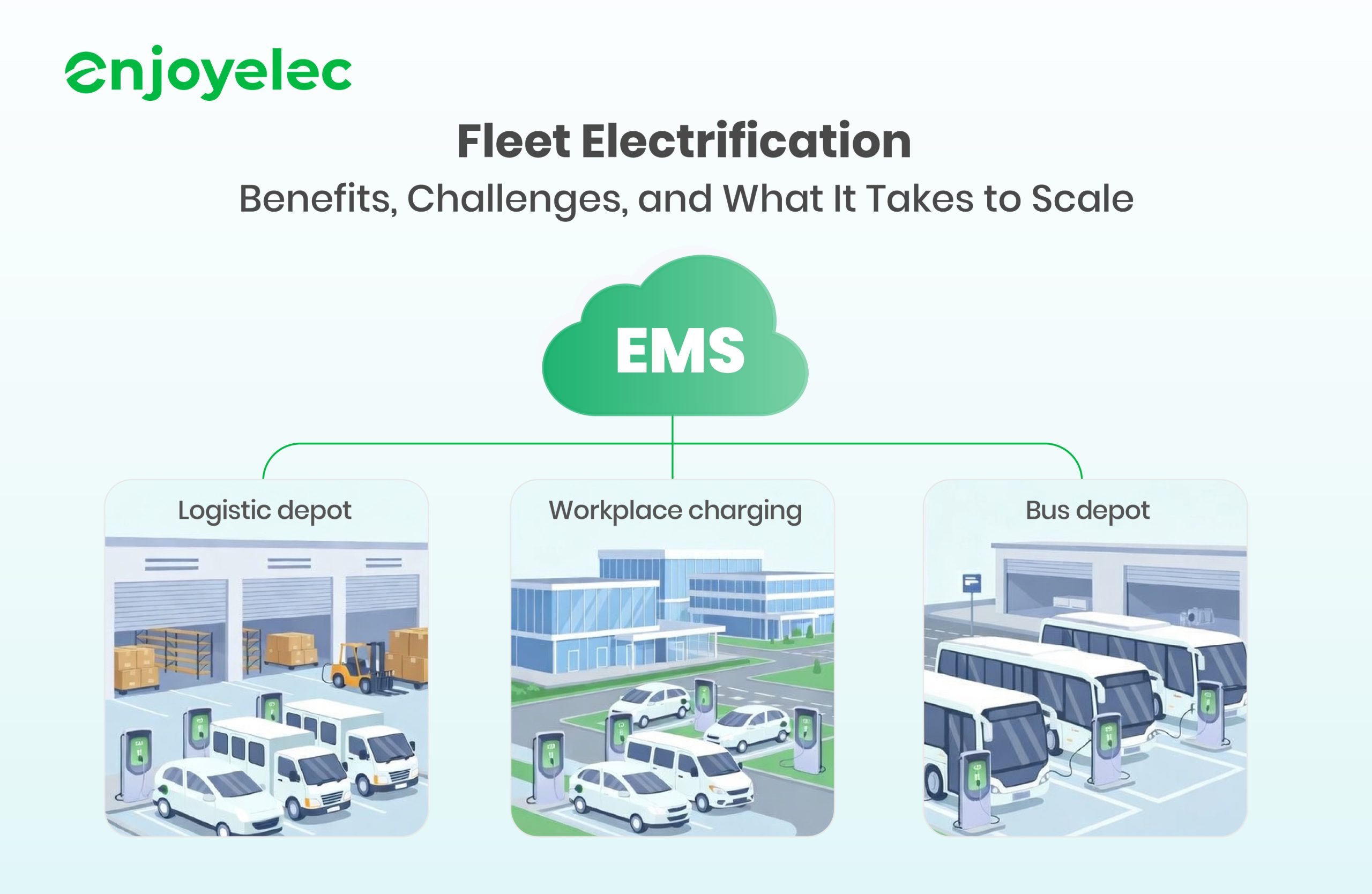
What is fleet electrification?
-
EVs selection and deployment planning
-
Charging infrastructure installation
-
Energy management and optimization
-
Smart charging strategies
-
Total cost of ownership (TCO) analysis
Organizations that approach fleet electrification holistically are more likely to achieve both cost savings and operational efficiency.
Benefits of Fleet Electrification
Fleet electrification plays a critical role in reducing transport-related emissions and supporting global decarbonization goals.
Energy Optimization Opportunities
With the right energy strategy, fleets can optimize when and how they charge vehicles, reducing electricity costs and improving efficiency.
Regulatory and Market Advantage
In regions such as Europe, fleet electrification is increasingly linked to regulatory compliance, including low-emission zones and decarbonization targets.
Key Challenges in Fleet Electrification
Despite benefits and the great momentum, fleet electrification still faces real-world constraints.
1. Charging Infrastructure and Grid Capacity
Charging infrastructure remains one of the biggest barriers. In many regions, depot charging projects face delays due to permitting, installation timelines, and grid connection constraints.
Even in advanced markets like Europe, grid capacity limitations continue to slow deployment.
2. Policy and Regulatory Complexity
Fleet operators often face a fragmented policy landscape. Regulations, incentives, and timelines vary between countries. National-level differences can complicate cross-border fleet operations. For fleets making investment decisions five to seven years out, that complexity and unpredictability means risk. And this often leads to wait-and-see approach.
3. High Upfront Costs and Financial Uncertainty.
While EVs can deliver long-term savings, initial investment costs remain higher. In addition, uncertainty around residual values and technology evolution adds financial risk.
4. Energy Cost Management
Charging every vehicle at peak times can significantly increase electricity costs and demand charges. Without smart charging , fleets risk undermining the economic benefits of electrification.
5. Data Fragmentation and Lack of Integration
Fleet electrification generates data across vehicles, charging systems, and energy platforms. However, these systems are often not fully integrated.
This lack of interoperability limits visibility, reduces efficiency, and makes large-scale optimization more difficult.
What Does It Take to Scale Fleet Electrification?
1. Integrated Infrastructure Planning
First and foremost, fleets need certainty that charging infrastructure will be in place when and where it’s needed. Visibility into grid capacity enables better planning, while aligning infrastructure rollout with vehicle deployment improves execution.
2. Stable and Predictable Policy Environment
Policy stability works the same way. Clear, long-term policy frameworks help reduce investment risks and enable faster decision-making. It means fleets can commit to electrification without hedging their bets or waiting to see what happens next.
3. Smart Charging and Energy Management
Smart charging and energy management take this further. Intelligent systems that shift charging to off-peak hours , integrate with energy markets, and enable V2G applications where regulatory frameworks and hardware capabilities allow, protect savings and create new value with existing capacity . Fleets stop being passive energy consumers and start becoming active grid participants in energy and flexibility markets, with the potential to generate revenue from the assets they already own.
4. Data interoperability and open standards
Data integration multiples the value of electrification. Standardized communication protocols and open platforms enable seamless communication across systems. Fragmented information thus becomes actionable intelligence, inspiring precise decisions, and improving energy efficiency. This is especially important for multi-site or cross-border fleets.
5. Transparent TCO
TCO refers to the full lifecycle cost of a vehicle, including purchase price, energy or fuel costs, maintenance, and residual value. Clear TCO models help understand the true financial impact of fleet electrification, beyond upfront investment. Innovative financing mechanisms (e.g., battery leasing, EV-as-a-service models) can further support adoption by reducing initial capital requirements and aligning costs with long-term savings.
The future of Fleet Electrification
-
From procurement to optimization;
-
From infrastructure to energy management;
-
From isolated data to connected ecosystems.
While the benefits are clear, success depends on execution. Organizations and operators that take a system-level approach, integrating vehicles, infrastructure, energy, and data, will be best positioned to succeed.
The question is no longer whether fleets will electrify, but how efficiently and how quickly they can scale.