
How enjoyelec HEMS solution achieves a remarkable 52% cost saving?
Introduction:
In the rapidly evolving landscape of home energy, achieving significant cost savings is often the primary motivation for adopting new technologies. Yet, for many early adopters who have invested in solar panels, home batteries, heat pumps, and electric vehicles, a core challenge remains: how to truly leverage these valuable assets to their full financial potential.
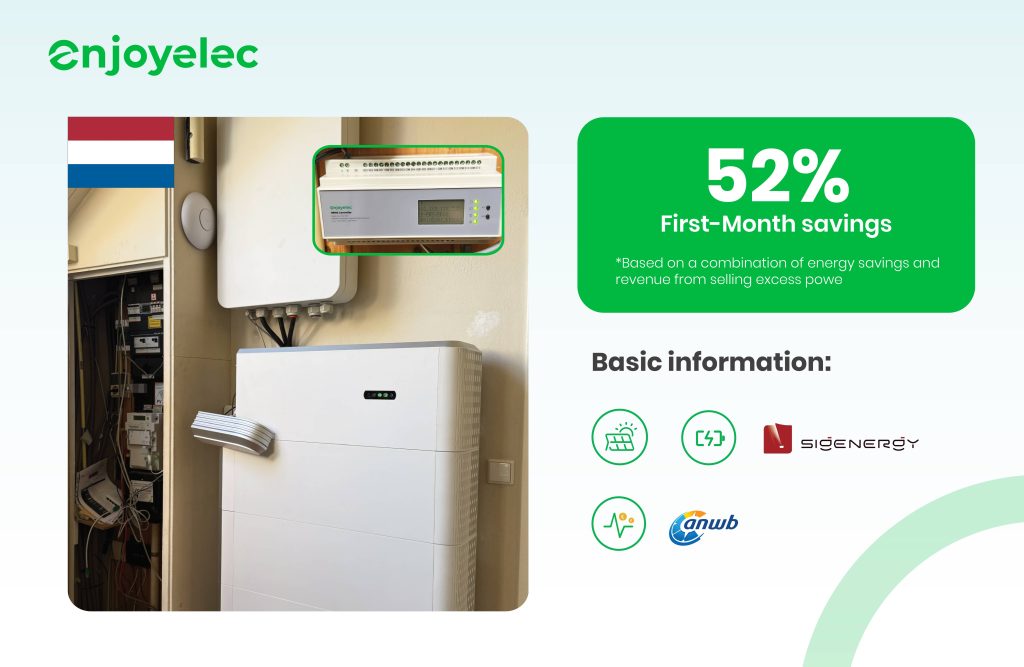
This is a challenge our latest success story from the Netherlands perfectly illustrates. A customer there was equipped with a powerful setup—a 20kW solar panel system and a 40kWh battery—but needed a way to truly optimize these valuable assets. To turn their investment into a profitable venture, they partnered with us to install the enjoyelec HEMS Controller pro.
The trust was awarded with a remarkable return. Our system seamlessly integrated all their devices—from solar panels, heat pump, and EV to batteries—into a single, intelligent ecosystem. This not only optimized their energy use but also actively generated revenue from the grid, leading to a remarkable 52% cost saving in their very first month.
The Challenge: Turning Green Assets into a Profitable Strategy
Our customer’s story is a classic example of a modern-day energy paradox. Many homeowners today are making a significant investment in clean energy assets like rooftop solar, home battery, and EV chargers. But (as this Dutch customer discovered),simply having the hardware is obviously not enough. More users gradually realized that without a central brain to manage these assets, they were operating as independent silos. The customer’s main pain points include:
1. Navigating Volatile Prices: The dynamic tariff in energy market meant many consumers were still exposed to expensive peak-hour rates and were unable to sell power back to the grid at the most profitable times.
2. Wasted Potential: Their solar panels were generating significant power during the day, but without intelligent management, surplus energy was either sold back to the grid at a low rate or simply lost. The battery was a powerful tool, but its charge and discharge cycles weren’t aligned with market prices.
3. Lack of Control and Insight: They had no real-time overview of their energy flow or the financial impact of their consumption habits. The lack of data made it impossible to actively control costs.
They needed a solution that could transform their disconnected hardware into unified, proactive financial assets.
The Solution: A Central Brain for the Home
This is where the enjoyelec HEMS controller comes in. Supported by advanced interoperability, our system can seamlessly integrated all of their devices—from the solar panels and heat pump to the EV charger and batteries—under a single, intelligent platform.
Instead of just monitoring power, our HEMS controller became the central orchestrator, employing AI-powered strategies to make proactive decisions in real time. The system’s core functions include:
1. Real-Time Price & Consumption Analysis: It constantly analyzed live grid prices and predicted the home’senergy needs, scheduling charging and discharging cycles for maximum profitability.
2. Automated Energy Arbitrage: The controller automatically charged the battery when electricity prices were at their lowest and discharged it during expensive peak hours, allowing the customer to save on their bill or even sell energy back for a profit.
3. Optimized Self-Consumption: The system ensured that solar energy was used to its most and sold to the grid when prices were highest.
So, how did these functions work together to achieve such a remarkable 83% cost saving? The answer lies in the strategic application of these core principles, as shown in the two strategy studies below, demonstrating how our system creates value for the Dutch Customer.
Strategy 1: The Smart Saver’s Calculated Moves
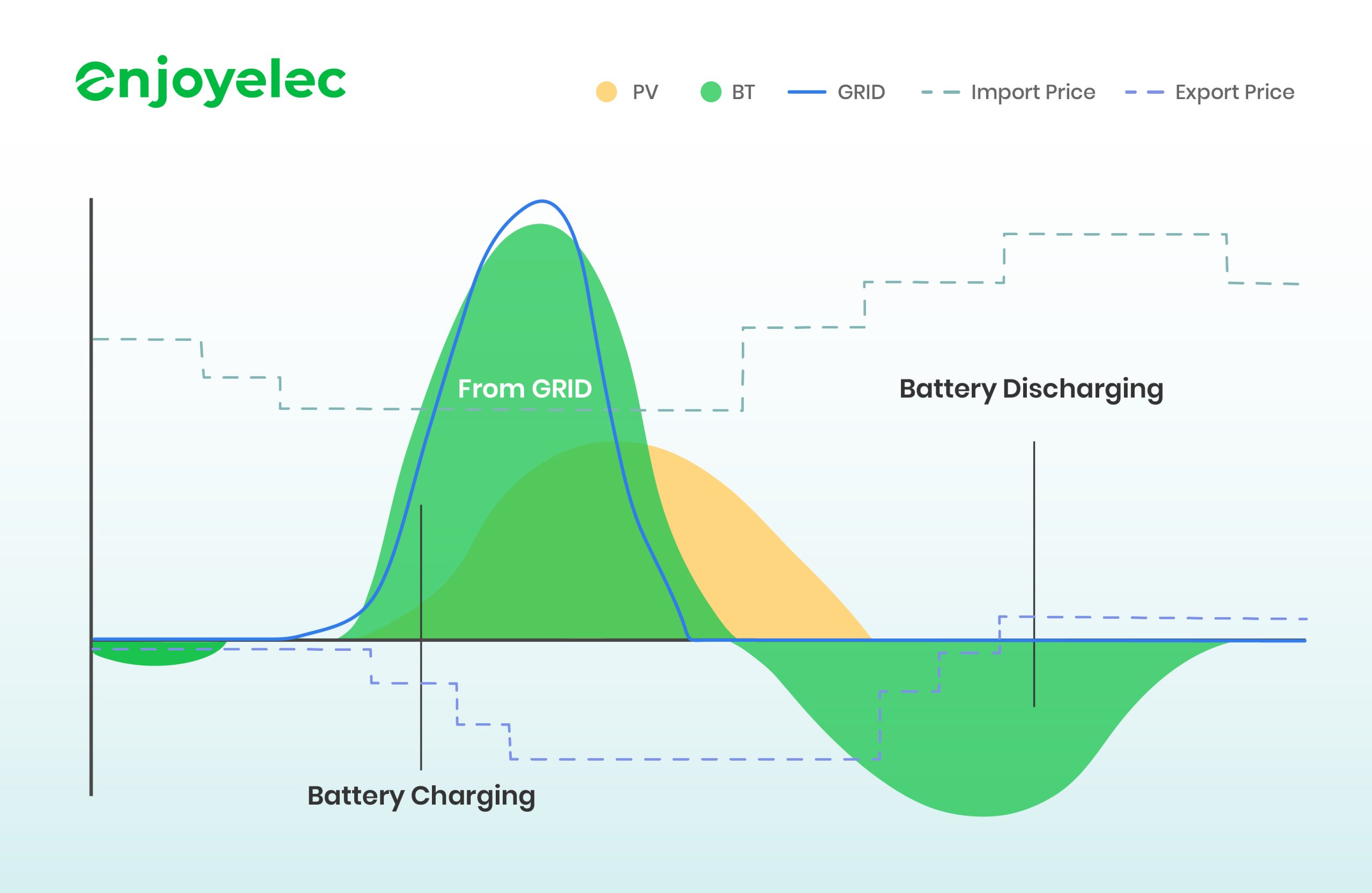
As the image vividly shows, our HEMS solution acts as the central brain of the family. By combining precise tariff and load prediction, it intelligently orchestrates the battery’s charge and discharge cycles, decisively pulling from the grid only at its low price.
The tariff fluctuates during the day, as does the home load. Energy prices and home load usually curve follow a similar trend. The trend makes perfect sense. Home load is typically at its highest when people are most active at home and the solar production is weak, generally occurring from late afternoon to the next morning—the hours after work and before people head out for the day. Energy prices slowly fluctuate downward from their peak as the home load during this period.
Our HEMS AI is an expert at dealing with these complex changing conditions. During peak hours, which correspond to the highest grid prices, the HEMS AI intelligently manages battery discharge (the green line), using stored power to meet the household demand. Acknowledging that the battery’s full capacity is insufficient to cover the load for this entire period (from 5 p.m. to 4 a.m.), the HEMS makes a crucial decision. It strategically pulls power from the grid for home load, but only during periods when the price is at its lowest (green dashed line,at 28ct/kWh or less).
This situation persists until around 9 a.m. As home load decreases, solar PV generation begins to ramp up, and grid prices continue to fall, the HEMS detects these ideal conditions for a new strategy. HEMS understands the PV generation fluctuates from day-to-day and today represents a PV deficit condition. The AI then strategically uses low-prices grid power to charge the battery and maintain it at full capacity. The goal is clear: to ensure the home is fully prepared to meet the sustained high load after 4~5 p.m. As a result, this proactive approach avoided an additional €1.65 in expense compared to a conventional self-consumption model, leading to 36% daily cost savings.
Strategy 2: The Energy Arbitrage Master
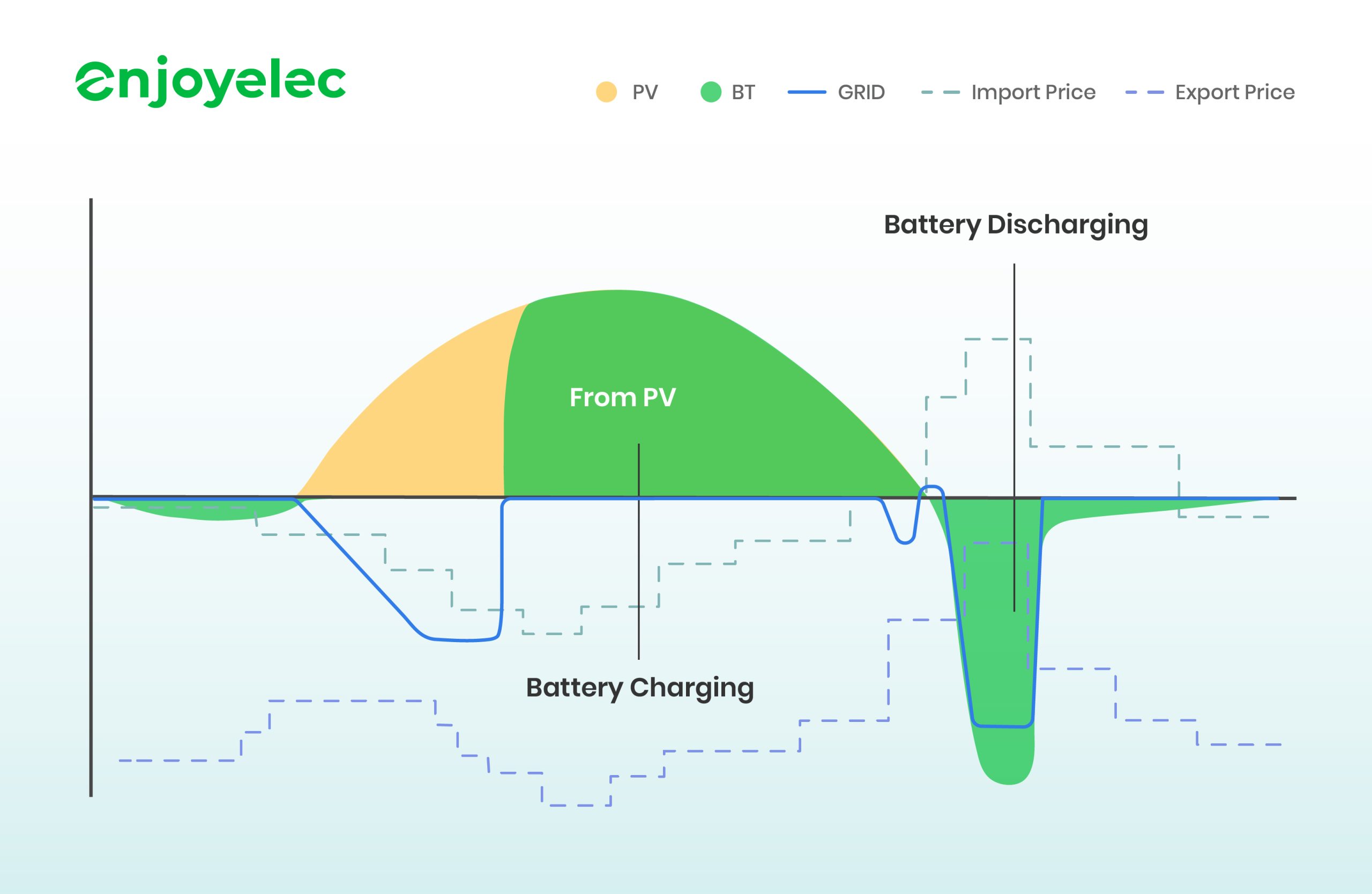
From midnight until sunrise, the battery powers the home, helping to save on costs, much like in the previous case study. But the real strategy begins as the sun rises.
By 8 a.m., PV generation rapidly increases and significantly exceeds household demand. The HEMS AI detects that the feed-in tariff is still at a high level. It makes a crucial decision to sell that excess PV power to the grid, immediately generating a profit. This strategy created €1 in additional revenue during this period alone.
The HEMS knows that the market is always changing. As the day progresses, the feed-in tariff gradually drops to its lowest point around noon. This is when the HEMS pivots its strategy. Recognizing that a high household load is expected in the evening, it uses all surplus solar power from noon until 6 p.m.to charge the battery to full capacity. It’s an intelligent decision to forgo a small, immediate profit in favor of a much larger one later.
The golden night approaches. Solar production has stopped completely, but the feed-in tariff has gradually reached its highest point of the day(the blue dashed line). The HEMS AI, using its intelligent predictions, activates the battery and sells the stored power back to the grid during the highest feed-in period.This single, calculated move maximizes the arbitrage accumulating a revenue of €3.6.The remaining household demand is then coordinated with grid power to cover household load while minimizing electricity costs.
In total, the HEMS solution’s smart trading generated a cumulative arbitrage profit of €4.6 for the day.
This inspiring saving demonstrates the power of our HEMS Controller, supported by powerful AI and cloud computing. Besides, for complete and intuitive experience, the HEMS Controller is complemented by our enjoyelec APP,which functions as a dashboard that provides a clear, real-time overview of your energy flow, savings, and earnings, giving you convenient access and control from anywhere.
The Result: Beyond Cost Savings
The outcome was a powerful validation of our technology. The 83% cost saving wasn’t just about eliminating an energy bill; it was about creating a new revenue stream. The customer’s assets, once disconnected, were now a profitable, high-performance unit, actively generating income.
This case study proves that with the right technology, homeowners can move beyond passively consuming energy to actively participating in and profiting from the energy market. It’s a clear indicator that the future of home energy starts with being green, but our technology goes a step further. It’s about being smartly green—unlocking potentials, empowering homeowner to be active participants in the energy market and achieving financial returns while contributing to a sustainable future.
