
Demand-Side Flexibility: A Scalable Solution to Grid Congestion
As renewable penetration accelerates and electrification expands across transport, heating, and industry, grid congestion is no longer an occasional operational issue. It is becoming a structural constraint to the energy transition.
Across Europe and many other energy markets, distribution networks were not designed for high volumes of distributed generation, bi-directional power flows, growing clustered EV charging, or electrified heating systems. The result is an increasing frequency of congestion events, solar curtailment, delayed grid connections, and mounting infrastructure costs.
Traditional grid-enhancing solution remains necessary, but it is capital-intensive and slow to deploy. The system requires a more adaptive solution.
This is where Demand-Side Flexibility (DEF) becomes critical.
Demand-Side Flexibility as system capability
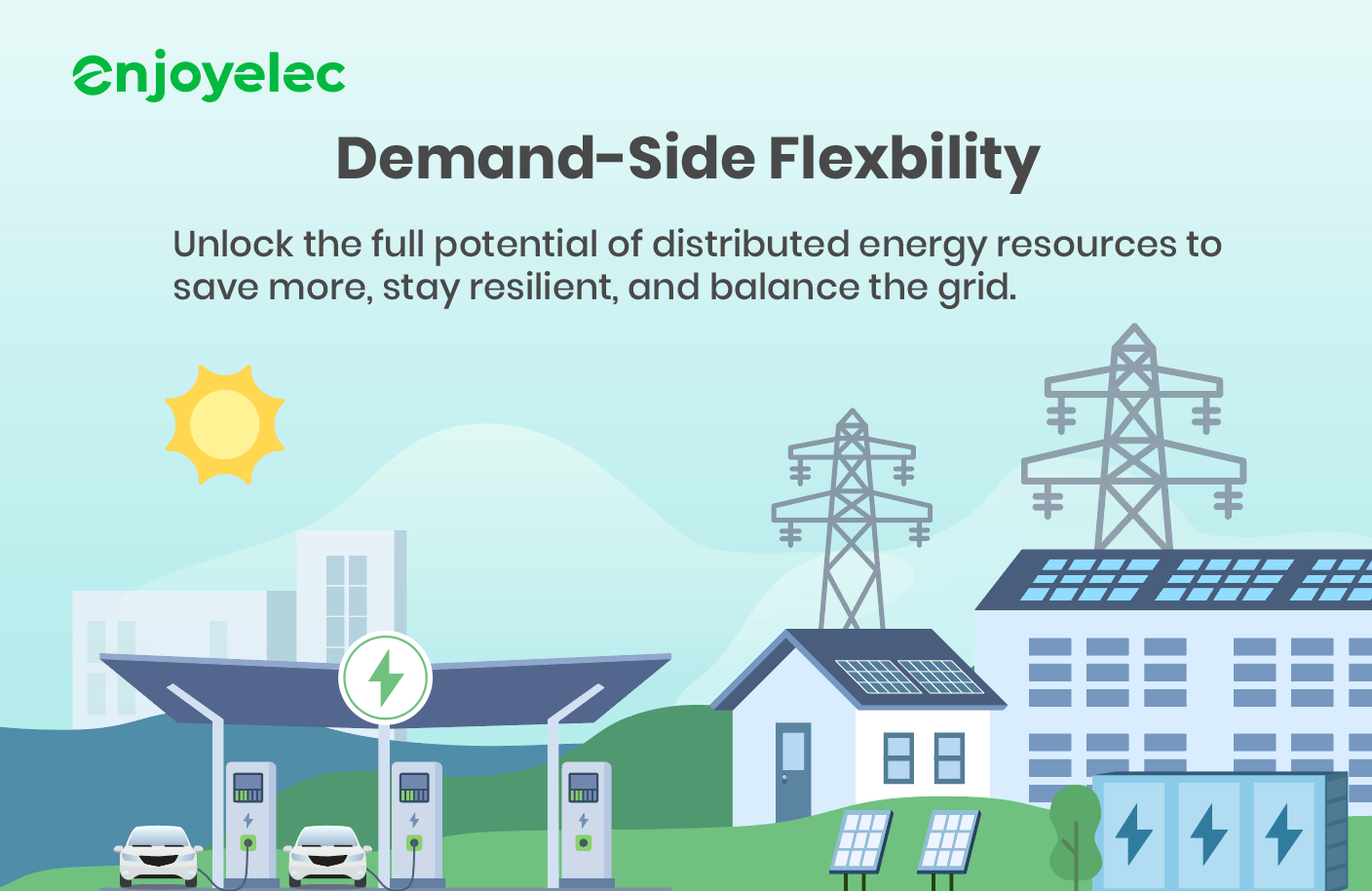
Demand-Side Flexibility refers to the ability of consumers to actively adjust consumption, storage, and distributed generation in response to grid conditions and price signals.
Unlike traditional event-based Demand Response programs, DSF represents a broader structural capability embedded within distributed energy resources. It encompasses various management strategies like intelligent peak shaving, behind-the-meter storage optimization, smart EV charging coordination, managed export control, and the aggregation of distributed resources into dispatchable portfolios. Rather than expanding infrastructure to meet inflexible peak demand, flexibility reshapes demand to align with available network capacity.
However, flexibility does not emerge automatically from connected assets. It must be intelligently orchestrated.
Realizing this capability at scale requires digital orchestration. Systems must collect high-resolution data, forecast demand and generation, optimize energy flows under multiple constraints, and automatically coordinate resources to ensure reliable and effective integration with the grid and markets. Advanced Energy Management System provides the foundational layer for this coordination.
AI-powered EMS achieves:
1.Granular Visibility and Control.
Effective flexibility begins with high-resolution data and controllability. Real-time monitoring of load profiles, on-site generation, battery state of charge, EV charging behavior, and contracted capacity limits enables accurate identification of available flexibility.
2.Automated Optimization Under Constraints
Manual demand adjustment is not scalable. EMS intelligent optimization engines dynamically coordinate energy flows based on grid congestion signals, dynamic tariffs, demand forecasts, weather forecasts, and user-specific demands.
-In residential settings, this enables EV charging to shift outside congestion windows, batteries to absorb surplus solar generation, and feed-in control during periods of grid stress.
–In commercial and industrial environments, similar orchestration reduces peak demand, minimizes demand charges, executes smart export control, and aligns operational process with network constraints.
3.Storage as a Congestion Mitigation Asset
Behind-the-meter battery systems are particularly effective in mitigating local constraints. When properly orchestrated, storage can absorb excess distributed generation, reduce reverse power flows, discharge during localized peak demand, and maintain site-level capacity compliance. Instead of curtailing renewable output, energy is shifted temporally, preserving both economic and environmental value. Batteries thus evolve from a self-consumption optimization tool into an active grid-support asset.
4.EV Charging as Managed Flexibility
Electric vehicle adoption is accelerating faster than network reinforcement. Unmanaged charging can significantly amplify residential peak demand, while managed charging can transform EVs into flexible loads. Orchestrated through intelligent EMS, EVs are capable of aligning with low-congestion periods while still meeting mobility needs. At scale, aggregated EV fleets can form a substantial and highly responsive flexibility resource within the distribution network.
5.Aggregation and Market Integration
The system-level impact of flexibility is amplified through aggregation. While individual assets provide localized benefits, coordinated portfolios create dispatchable capacity that can be integrated into local congestion management schemes, DSO flexibility programs, balancing markets, or Virtual Power Plant (VPP) integrations. It transforms distributed assets into a system-level solution.
Smartly manage your greener energy future
From an economic perspective, Demand-Side Flexbility complements traditional grid investment by unlocking capacity that already exists within homes and commercial facilities. By embedding intelligence directly into behind-the meter assets, our EMS turn distributed energy resources into coordinated system participants. Homes and businesses become active contributors to grid stability rather than passive sources of volatility.
Demand-Side Flexibility is therefore not an abstract concept. It is a practical capability delivered through advanced energy management, transforming distributed assets into coordinated grid resources and effectively supporting greener energy future.