Germany’s updated Federal Funding for Efficient Buildings Programme (BEG) changes both heat pump funding conditions and digital interface requirements. Lower eligible costs and reduced bonuses can increase homeowners’ upfront contribution, although some lower-income households receive stronger support. The revised rules also set out digital communication requirements for heat pump control and energy management.
For heat pump manufacturers and system integrators, this raises practical questions: does an existing SG Ready or digital interface provide the functions required by BEG? Understanding the required digital interfaces—and where EEBUS fits—helps identify what an existing product can support and what needs to be adapted.This article explains the changes to subsidy rates and eligible costs, why Germany is strengthening heat pump control, and how EEBUS and HEMS controllers can support integration.
1. What Has Changed in BEG Heat Pump Funding?
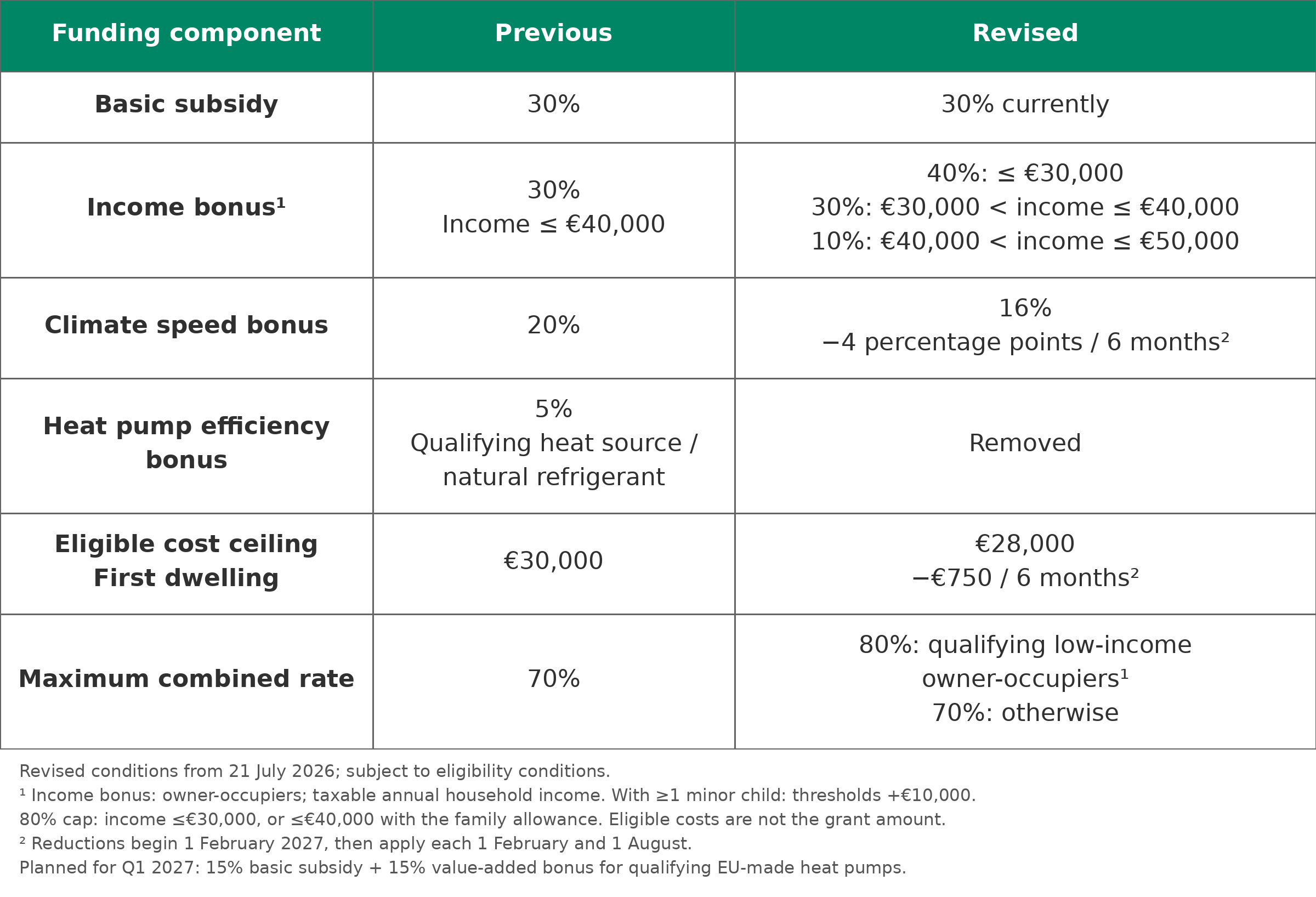
Germany's Federal Funding for Efficient Buildings programme (BEG) supports building renovation and eligible heating system replacements, helping customers manage the upfront cost of switching to a heat pump. Funding eligibility therefore matters to manufacturers and installers as well as homeowners.The revised funding conditions took effect on 21 July 2026, changing subsidy levels, bonuses and eligible costs.
The changes do not affect every household in the same way. Lower eligible costs and reduced bonuses can increase customers’ own contribution, while the revised income bonus provides stronger support for some lower-income households.The removal of the 5% efficiency bonus also means that qualifying natural-refrigerant heat pumps no longer receive that particular funding premium. For manufacturers, funding changes need to be considered alongside product pricing and technical eligibility.
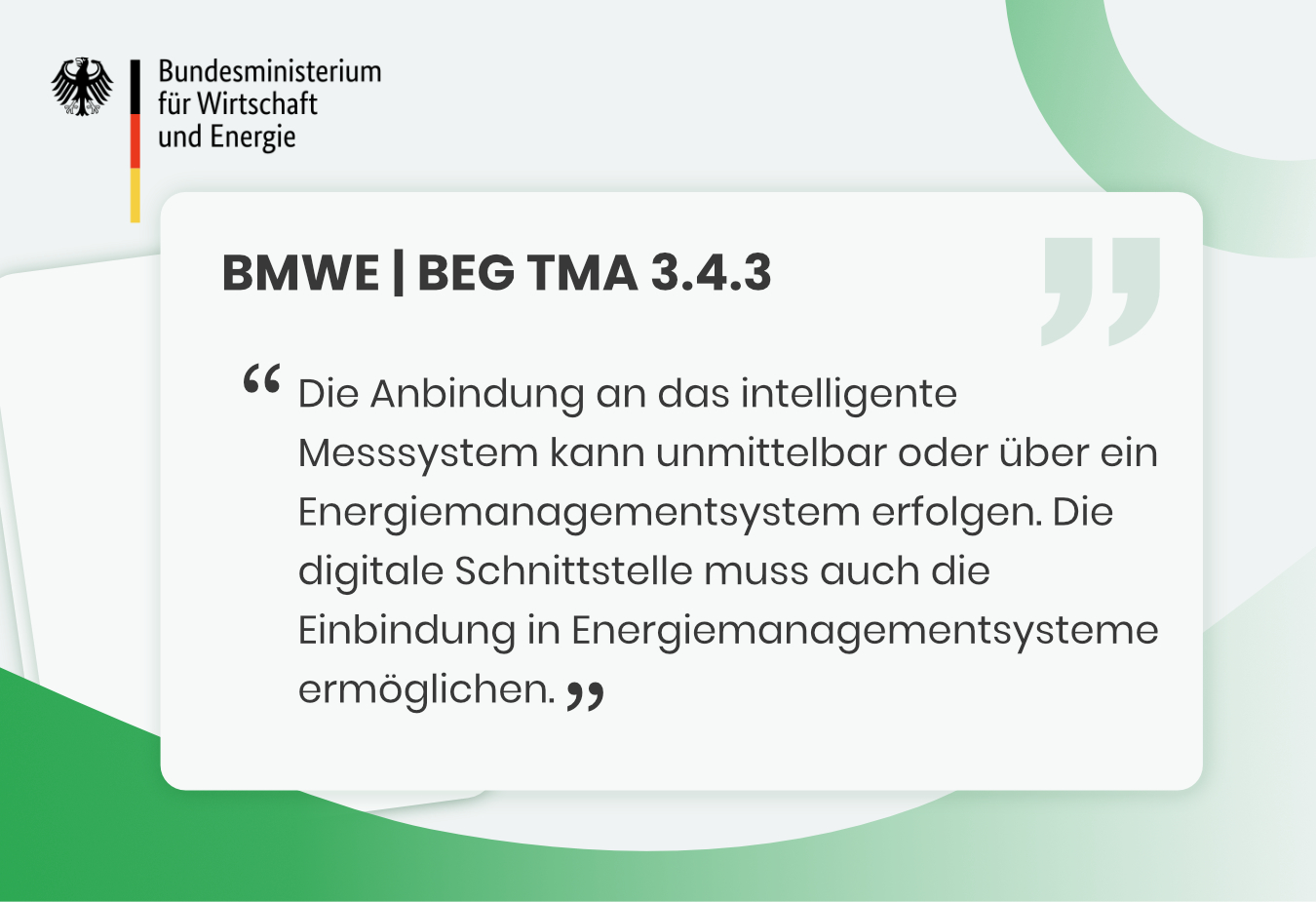
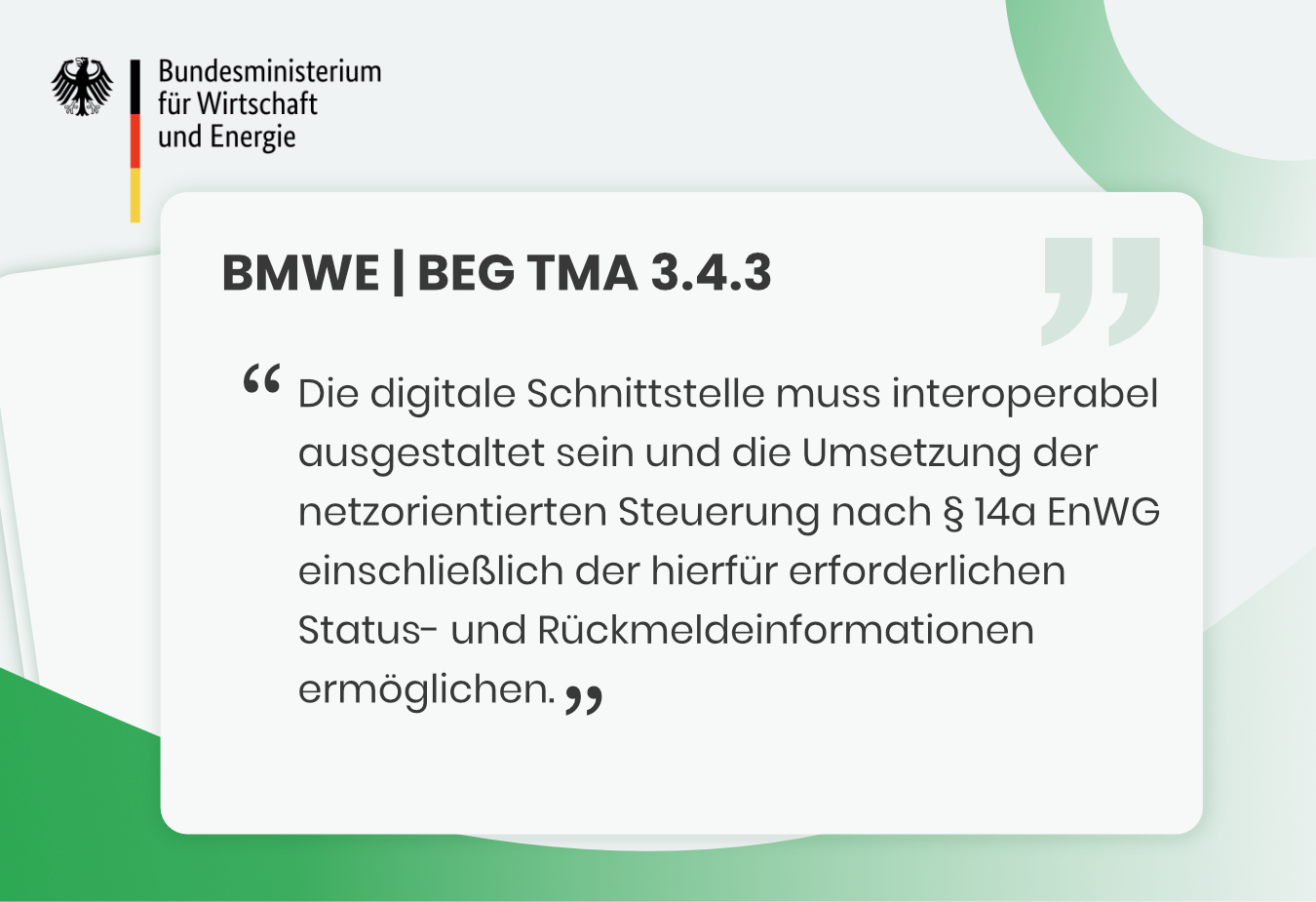
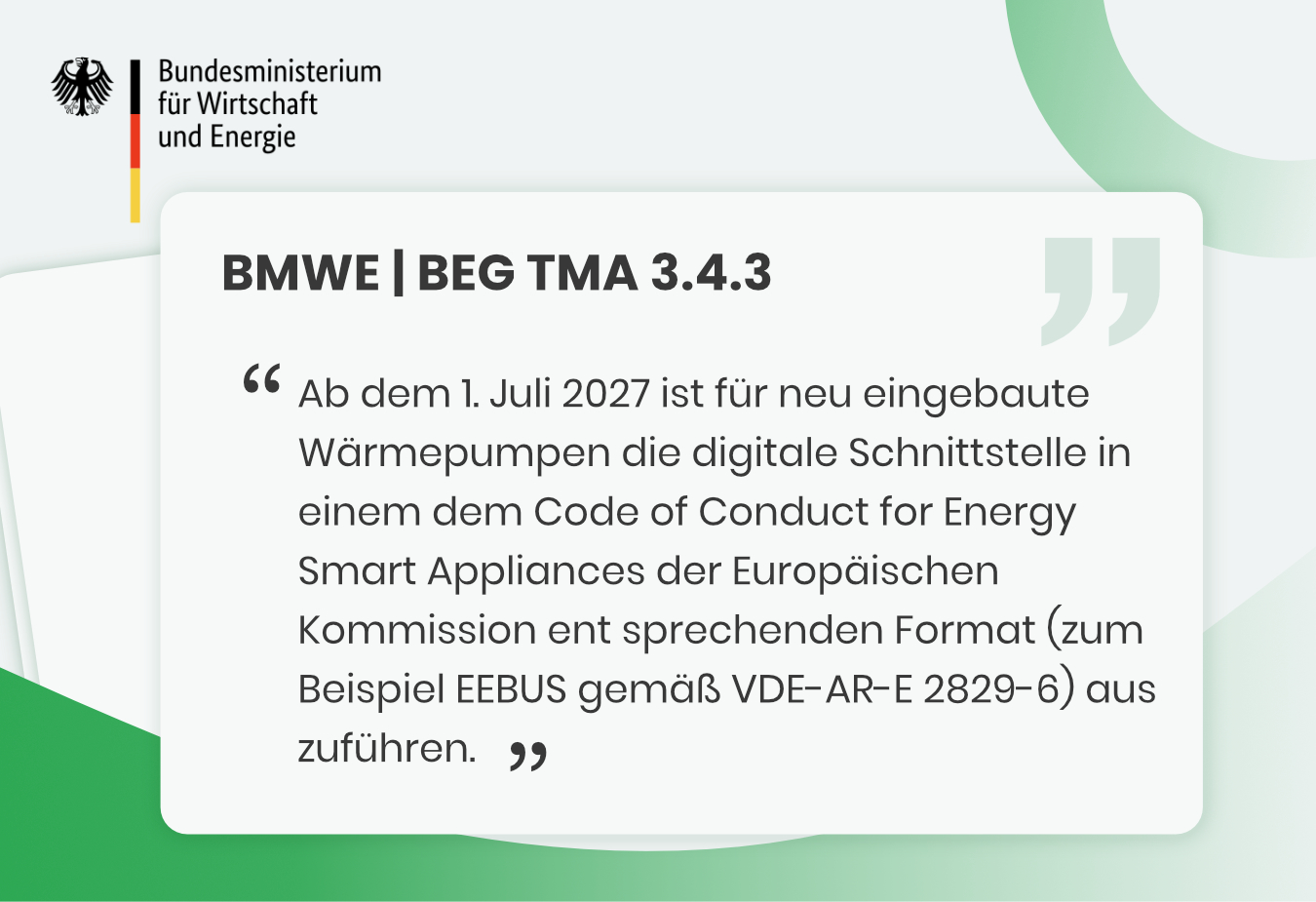
The revised rules also address heat pump digital interfaces. They specify interoperable communication supporting grid-oriented control under §14a EnWG, including the necessary status and feedback information, and integration with an Energy Management System (EMS).The guidelines allow connection to the intelligent metering system either directly or through an EMS. The interface must use a format corresponding to the European Commission’s Code of Conduct for Energy Smart Appliances, with EEBUS in accordance with VDE-AR-E 2829-6 explicitly named as an example.
2. Why is Germany Strengthening Digital Heat Pump Control?
Growing numbers of heat pumps, EV chargers and battery storage systems are increasing demand on local distribution grids, particularly during winter heating periods and evening charging peaks, when several devices may draw power at the same time. Germany is addressing this through grid expansion, digitalisation and controllable electricity demand.
Under the rules implementing §14a EnWG, applicable new devices connected from 1 January 2024 must allow their electricity demand to be temporarily reduced to help prevent local grid overload. In return, network operators cannot refuse or delay connection solely because of possible local overload, and participating customers receive reduced network charges. Control can be applied directly to a device or through an EMS.
Smart metering, dynamic tariffs and HEMS also create a need for more detailed device communication. Power limits and consumption data help systems coordinate heat pumps around electricity prices, PV generation and household demand, alongside grid-control requirements.
3. SG Ready vs. Digital Interfaces
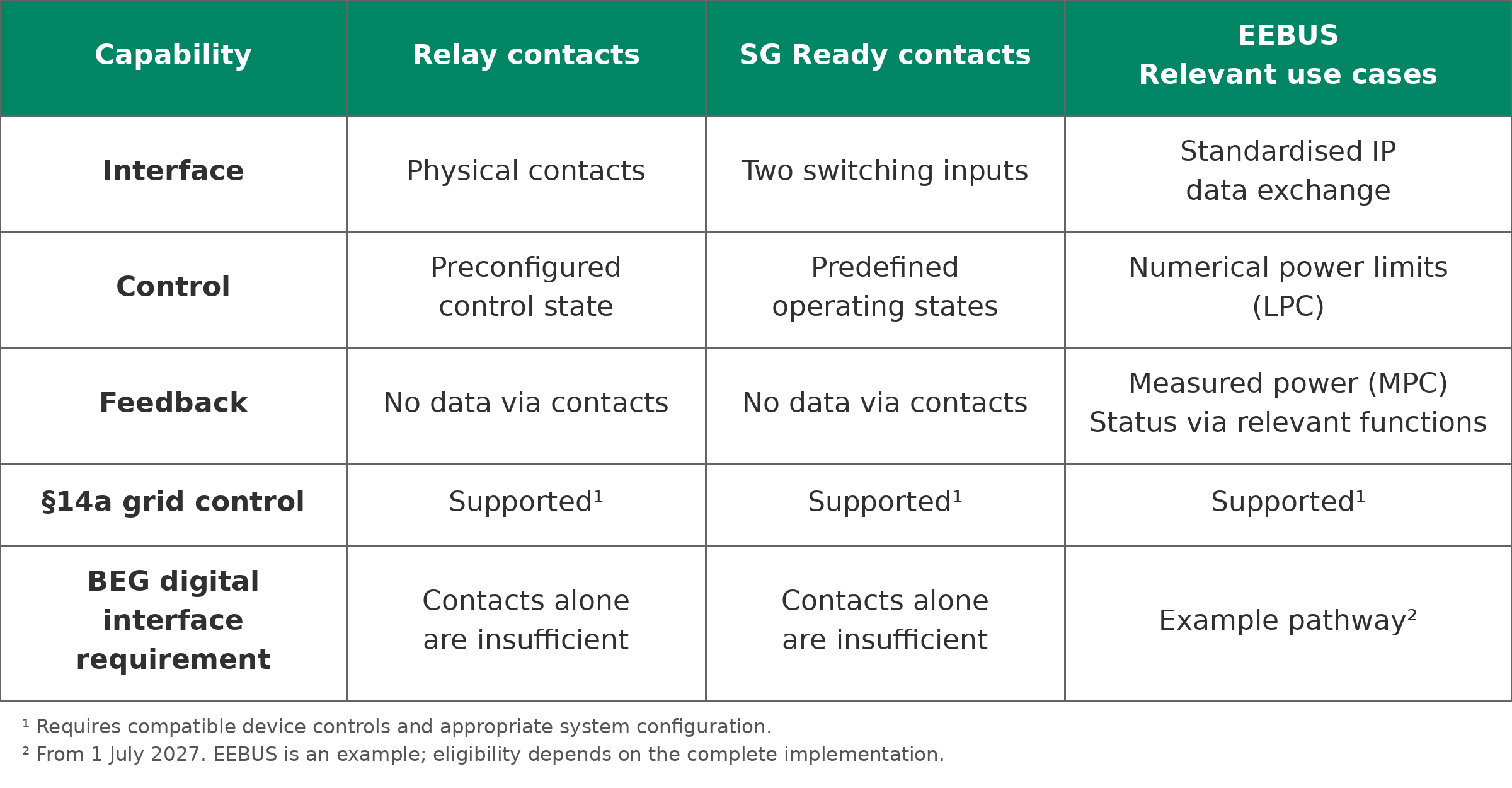
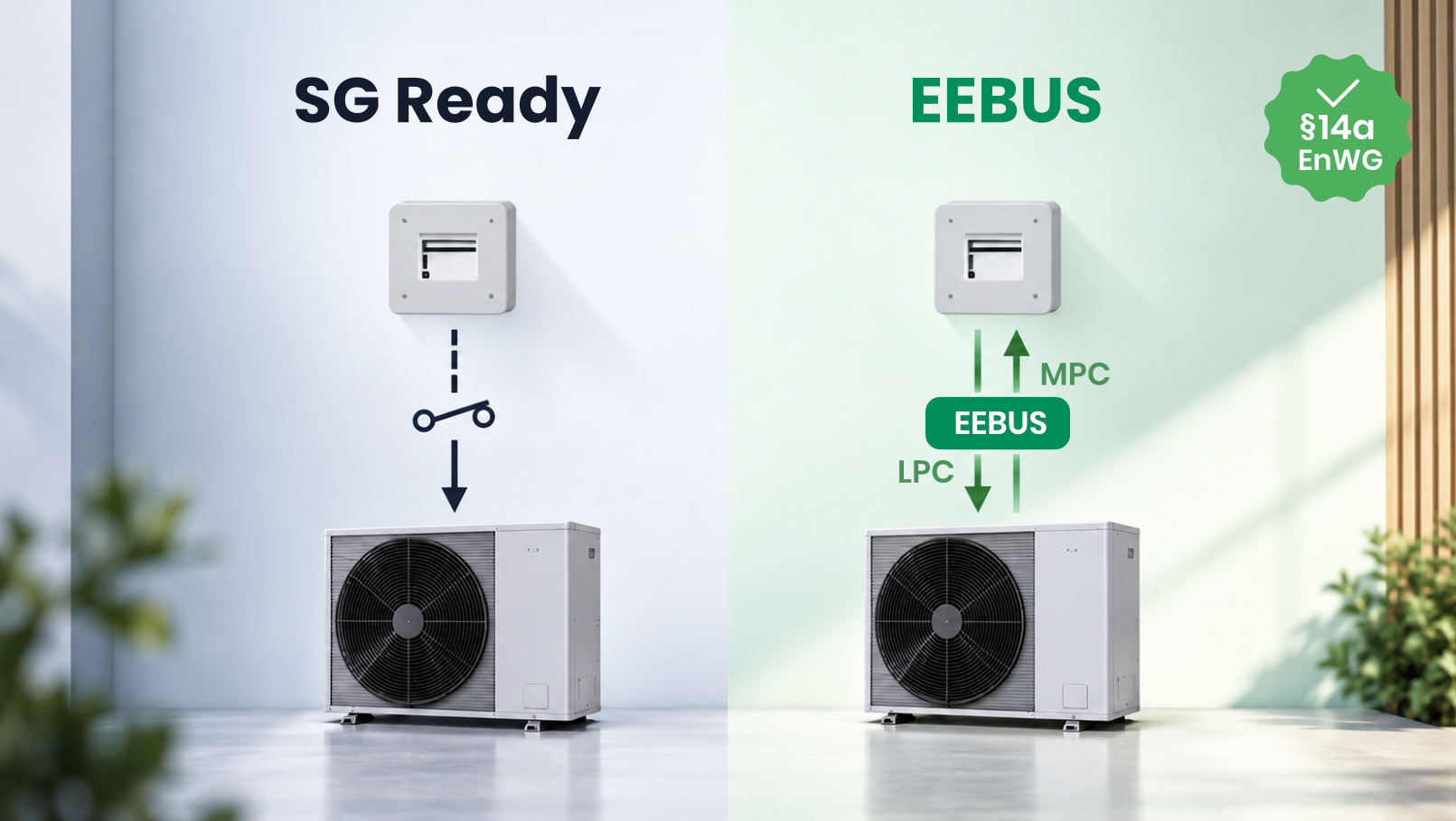
For heat pumps that already use SG Ready for external control, the question is whether this interface can meet the updated BEG requirements. SG Ready typically uses switching contacts (dry contacts) to select predefined heat pump operating states. This provides a straightforward way to respond to external signals, but the contacts themselves cannot transmit numerical power limits or return measured electricity consumption.
To support these functions, heat pumps need a digital interface that can exchange power limits, consumption data and operating status with a HEMS or grid-control device.
4. Why EEBUS for Heat Pump Integration?
EEBUS defines common data models and use cases for communication between energy devices and control systems. For heat pumps, two particularly relevant use cases are LPC and MPC.
LPC — Limitation of Power Consumption
LPC communicates the maximum permitted electrical power consumption to the heat pump. The heat pump’s own controller then adjusts operation within its equipment constraints.
MPC — Monitoring of Power Consumption
MPC reports actual electrical power consumption to the HEMS or monitoring device. This allows measured power to be compared with the requested limit and provides data for household energy management.Together, LPC and MPC support power limitation and consumption monitoring. The implementation must also provide the other status and feedback information required for the intended control arrangement.
EEBUS’s value is also in how different systems interpret the exchanged information. With a device-specific Modbus interface or private API, integrators often need to map register addresses, units and command behaviour for each product.
EEBUS defines these external interactions through shared specifications. This helps heat pumps, HEMS and grid-control devices communicate across brands and reduces repeated interface development. It makes EEBUS a practical implementation option for the interoperable digital interface described in BEG.
5. How can EEBUS be Implemented in a Heat Pump System?
EEBUS communication can be implemented within the heat pump's control or communication module. Alternatively, an external controller can provide EEBUS communication while exchanging commands and data with the heat pump through a supported local interface.This external approach depends on the functions the heat pump already exposes. An interface that reads temperatures or changes operating modes does not necessarily support numerical electrical power limits or consumption feedback.
Existing heat pump products already demonstrate different implementation architectures. Living Lab Cologne's Pilot-Qualified Devices list includes combinations using communication gateways from Bosch, Buderus, Vaillant and WOLF, with the listed scope tied to specific products, firmware and use-case scenarios.
6. Heat Pump Integration with enjoyelec HEMS Controllers
The appropriate integration approach depends on the existing heat pump interface.
For heat pumps with SG Ready contacts only, manufacturers first need to assess whether the control system can apply numerical power limits and provide the necessary feedback. Firmware, measurement or interface upgrades may be needed before digital integration.
For heat pumps with suitable local digital functions, an external HEMS controller can map those functions to EEBUS. The controller translates power limits into supported heat pump commands and returns consumption and status data to the connected system.
enjoyelec's Controller Lite and Controller Air 2 have achieved EEBUS Pilot Qualification for LPC, LPP and MPC. LPC and MPC support heat pump power limitation and monitoring, while LPP extends the controllers' capabilities to generation-side power limitation.
With a compatible heat pump interface, the controllers can support the control and feedback functions described in BEG. Beyond grid control, enjoyelec's HEMS coordinates supported heat pumps with PV systems, batteries and EV chargers. Its cloud-edge architecture combines energy optimisation with local device control, allowing operation to account for available solar generation, dynamic electricity prices and household demand.
Depending on the available heat pump functions, this can support solar self-consumption, shifting suitable heating demand to lower-price periods and coordinating household loads while respecting grid limits and heating requirements.
7. EEBUS and Interoperability in Germany’s Energy Systems
The BEG interface requirements reflect a growing need for heat pumps to work with grid-control devices and energy management systems. For manufacturers and system integrators, compatibility with these systems is becoming an important consideration alongside established requirements for heating performance.EEBUS offers a standardised approach to communication across supported heat pumps, EV chargers, PV systems and batteries. Its defined use cases can reduce device-specific integration work and support both grid control and coordinated energy management.
For heat pump manufacturers, the interface decision therefore extends beyond BEG funding requirements. It also affects how products connect to local control systems and participate in household energy management. EEBUS is one option to evaluate against these deployment needs.
8. Discuss Your Heat Pump Integration Requirements
enjoyelec supports heat pump integration through its HEMS controllers. Share your device model, interface documentation and planned system configuration to discuss integration options and testing.Request an Integration Assessment: business@enjoyelec.net
Funding eligibility is subject to the applicable BEG requirements and KfW assessment. Planned measures and future implementation details should be checked against the latest official guidance.