
Germany Grid Fee Reform 2029: What AgNes Means for C&I and BESS
Germany’s latest AgNes draft turns grid capacity into a cost decision that C&I and battery storage operators can no longer leave in the background.
From 2029, larger electricity users may need to select an annual billing capacity and pay a higher tariff on electricity withdrawn above that level. New purely grid-connected standalone BESS projects, meanwhile, could face a capacity-based grid fee, while dynamic grid fees for storage connected at medium voltage or above are planned to follow between 2030 and 2033.
AgNes remains under consultation. The final rules and tariff levels may still change.
How AgNes Would Change Grid Fees for C&I Sites
Today, many C&I users in Germany pay a demand-based grid charge, known as a Leistungspreis. Under this model, the charge is largely determined by the site’s highest measured load during the year, which means even a short peak can increase the demand charge applied for the year.
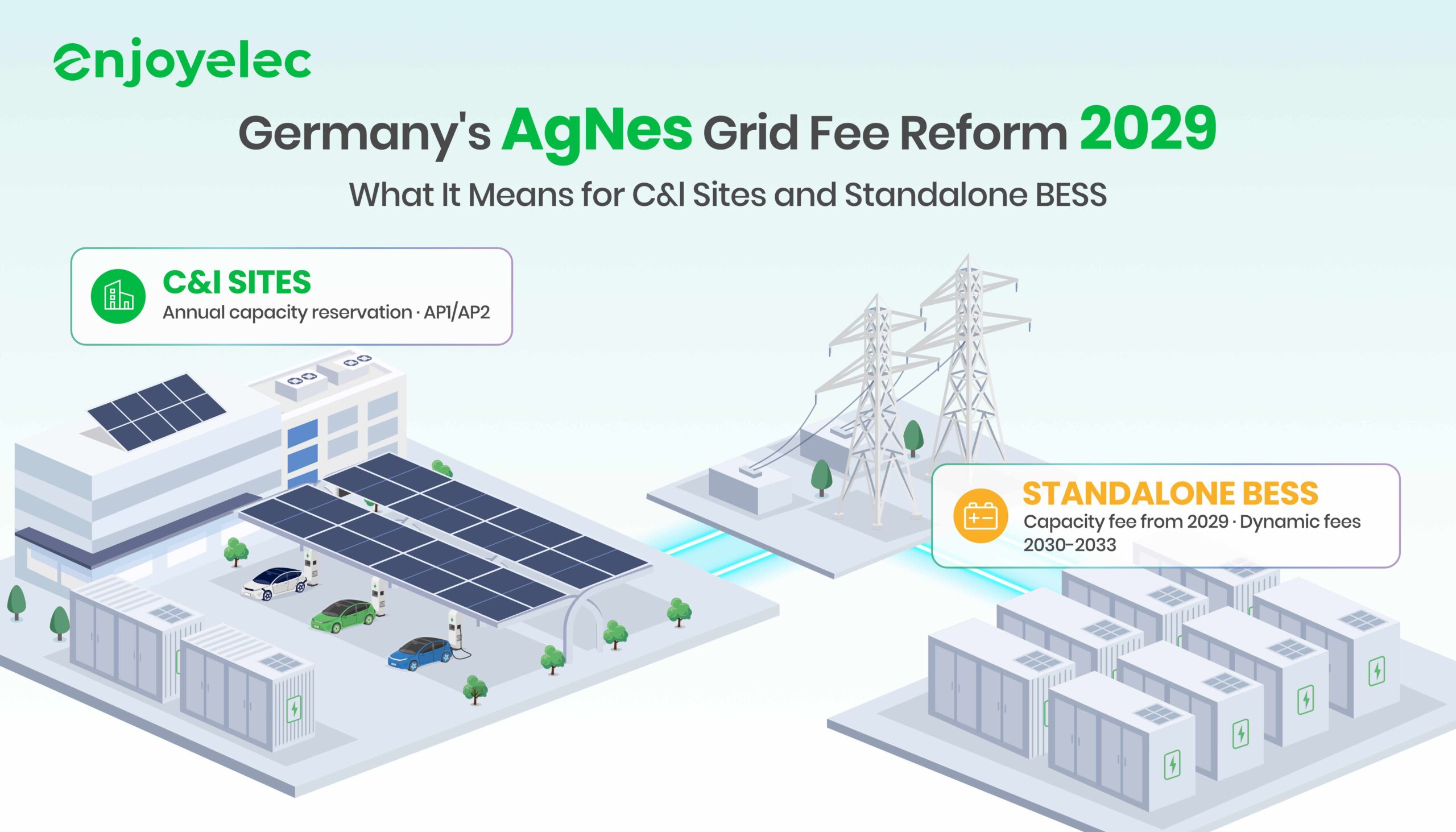
The AgNes draft would replace this charging model. Consumers connected above low voltage, as well as low-voltage sites using more than 100,000 kWh per year, would instead be billed against an annual capacity level in kW, known as Bestellkapazität, based on expected demand for the coming year. In each 15-minute interval, electricity withdrawn from the grid within the reserved level would be billed at AP1, and the portion above would be billed at AP2. Both AP1 and AP2 are energy-based rates in ct/kWh, with AP2 proposed at between 200% and 350% of AP1.
The draft creates a cost trade-off: reserving more capacity raises the fixed annual capacity charge but keeps more electricity withdrawn from the grid within AP1; reserving less reduces the fixed charge but exposes more electricity withdrawn from the grid to AP2.
The right choice therefore changes from avoiding every peak to actively deciding which peaks are economical to manage, shift, or just accept.
Germany’s latest AgNes draft turns grid capacity into a cost decision that C&I and battery storage operators can no longer leave in the background.
From 2029, larger electricity users may need to select an annual billing capacity and pay a higher tariff on electricity withdrawn above that level. New purely grid-connected standalone BESS projects, meanwhile, could face a capacity-based grid fee, while dynamic grid fees for storage connected at medium voltage or above are planned to follow between 2030 and 2033.
AgNes remains under consultation. The final rules and tariff levels may still change.
How AgNes Would Change Grid Fees for Standalone BESS
Standalone BESS projects in Germany can currently qualify for a 20-year exemption from net-access charges on electricity withdrawn for storage under §118(6) EnWG. The AgNes draft would phase out this treatment for new projects and introduce a dedicated tariff structure.
Under the current draft, projects still under development would retain the exemption only if they reach FID before the AgNes determination is announced—currently planned for 1 January 2027—and enter operation by 4 August 2029. The FID must also be evidenced to the relevant grid operator by 31 March 2027.
According to the draft, projects outside the exemption would pay a fixed annual grid fee based on contracted grid connection capacity from 1 January 2029, or from the commissioning date if later. Separately, dynamic grid fees are planned between 2030 and 2033 for storage connected at medium voltage or above. This provision is not limited to standalone BESS projects subject to the new fixed capacity fee.
How AgNes Changes Operating Decisions
For C&I sites, the main challenge is that Bestellkapazität must be selected before the year begins, while the cost outcome depends on how the site actually operates throughout the year. The same reserved capacity can produce very different grid fees depending on how often demand exceeds it, how long those periods last and how much electricity is consumed above the threshold.
Operators would therefore need to translate expected production, load growth and planned electrification into an annual capacity decision, then manage actual demand against that level during operation. For example, when an exceedance is expected, the site must decide whether to shift flexible consumption, discharge the battery, reduce a non-critical load or accept AP2 because maintaining production is more valuable.
For standalone BESS, the 2029 capacity fee mainly adds a predictable annual cost based on grid connection capacity. The larger operational change comes with dynamic grid fees, planned for medium-voltage and higher connections between 2030 and 2033. Because the fee would vary by time and location, a charging or discharging schedule that is profitable in wholesale or ancillary-services markets may become more or less attractive. Operators would need the applicable fee before the day-ahead market closes and include it in dispatch alongside market commitments, connection limits and battery availability.
What the New Rules Mean in Practice
Managing these decisions effectively requires more than retrospective energy reporting. Operators need reliable forecasts, interval-level meter data and live monitoring at the grid connection, together with control that can coordinate flexible assets or translate market schedules into battery setpoints. An EMS can bring these inputs into one workflow and execute operating priorities locally, rather than simply display energy use.
What Operators Can Prepare Before 2029
Although the final tariff levels may change, AgNes points to a clear direction: grid costs will depend more closely on capacity planning and flexible operation. Operators can therefore prioritize four practical steps:
- Confirm the relevant grid connection and metering structure, then build a baseline from 15-minute import and export data, contracted grid connection capacity and planned new loads or assets.
- For C&I sites, compare several Bestellkapazität options against forecast demand and potential AP2 exposure.
- Assess whether the site needs—or already has—an energy management system capable of forecasting capacity exceedances, monitoring the grid connection, coordinating batteries and flexible loads, and receiving external tariff or market signals.
- For standalone BESS, include the proposed capacity fee in the project model, verify whether the FID and commissioning dates qualify for transitional protection, and prepare evidence of the FID for submission to the relevant grid operator by 31 March 2027 where applicable.
Preparing for 2029 starts with understanding how the grid connection is used and whether the site can respond when costs or constraints change. Talk to enjoyelec about how iEMS can bring grid monitoring, forecasting and coordinated asset control together for C&I and standalone BESS projects.