From Cost Center to Competitive Edge: The Strategic EMS in 4 Critical Scenarios
As industries navigate the dual pressures of cost and decarbonization, energy management has become strategic. The core mismatch between complex tariffs, intermittent renewables, and rigid demand leads to unpredictable costs and idle assets.
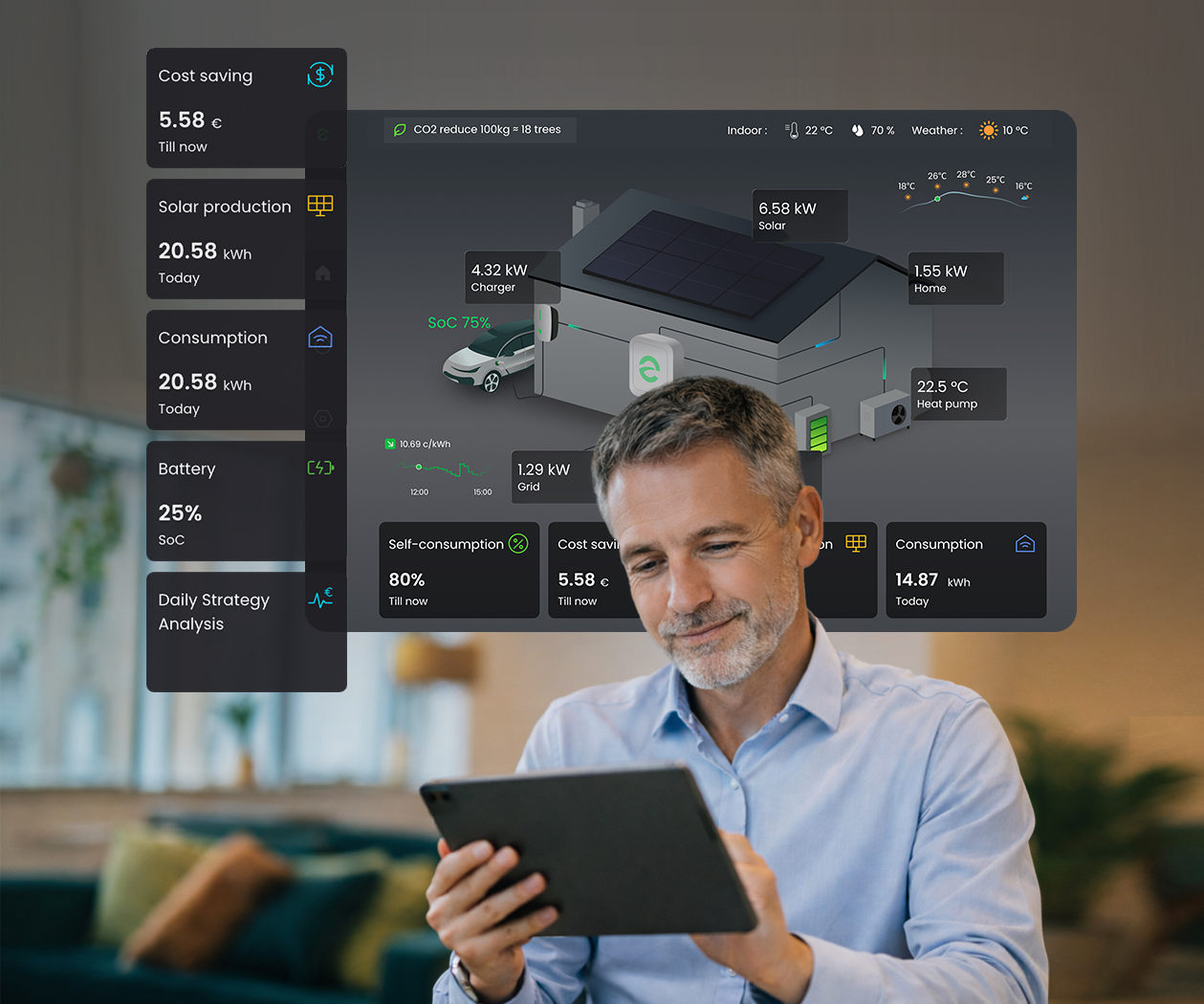
The solution is intelligent, data-driven orchestration—the core role of an Energy Management System (EMS). It bridges distributed resources, flexible loads, and dynamic markets to build resilience, unlock revenue, and ensure sustainability.
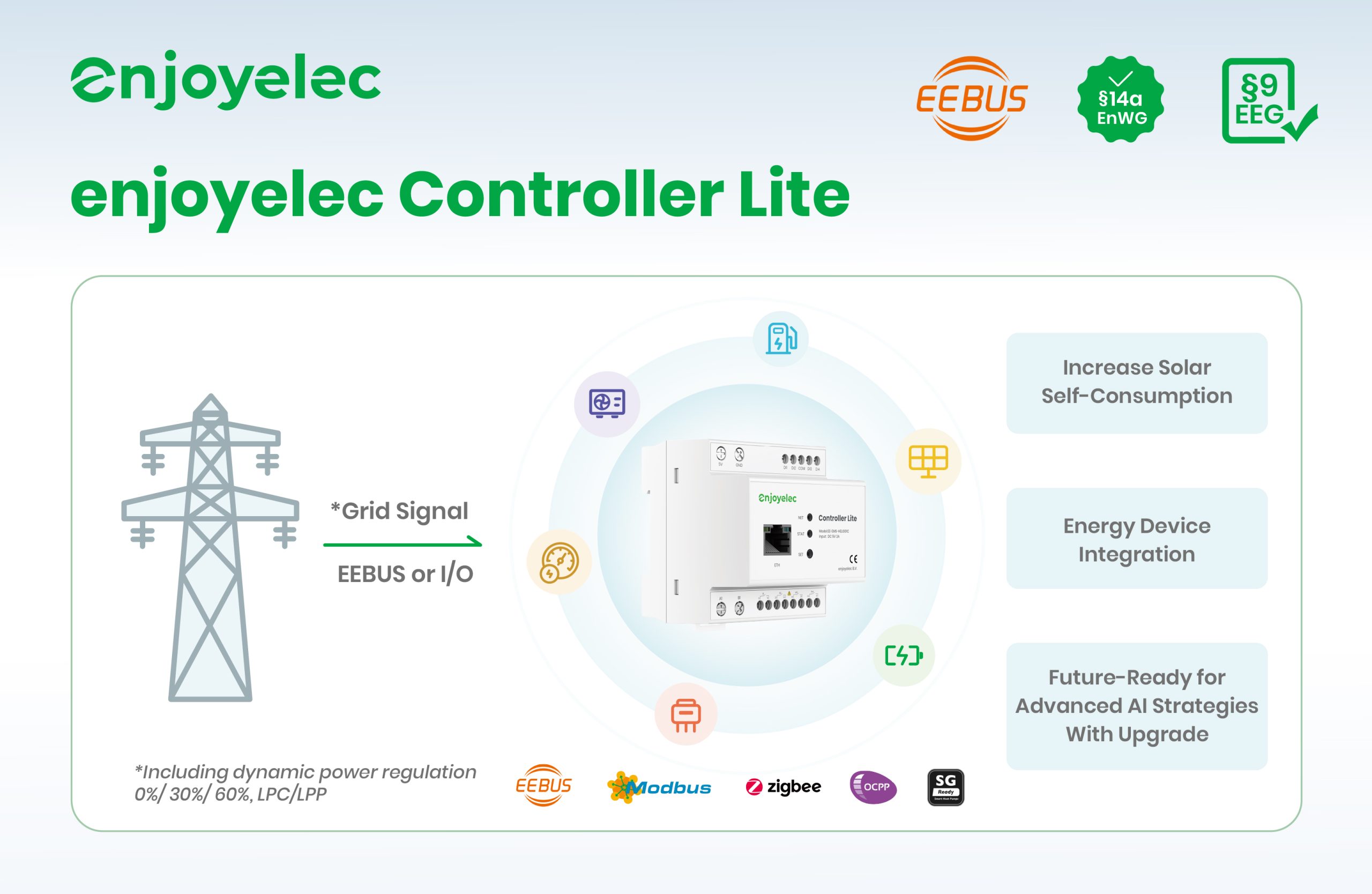
enjoyelec AI-powered EMS delivers targeted, high-impact value in four core scenarios:
1. Commercial & Industrial Energy Management
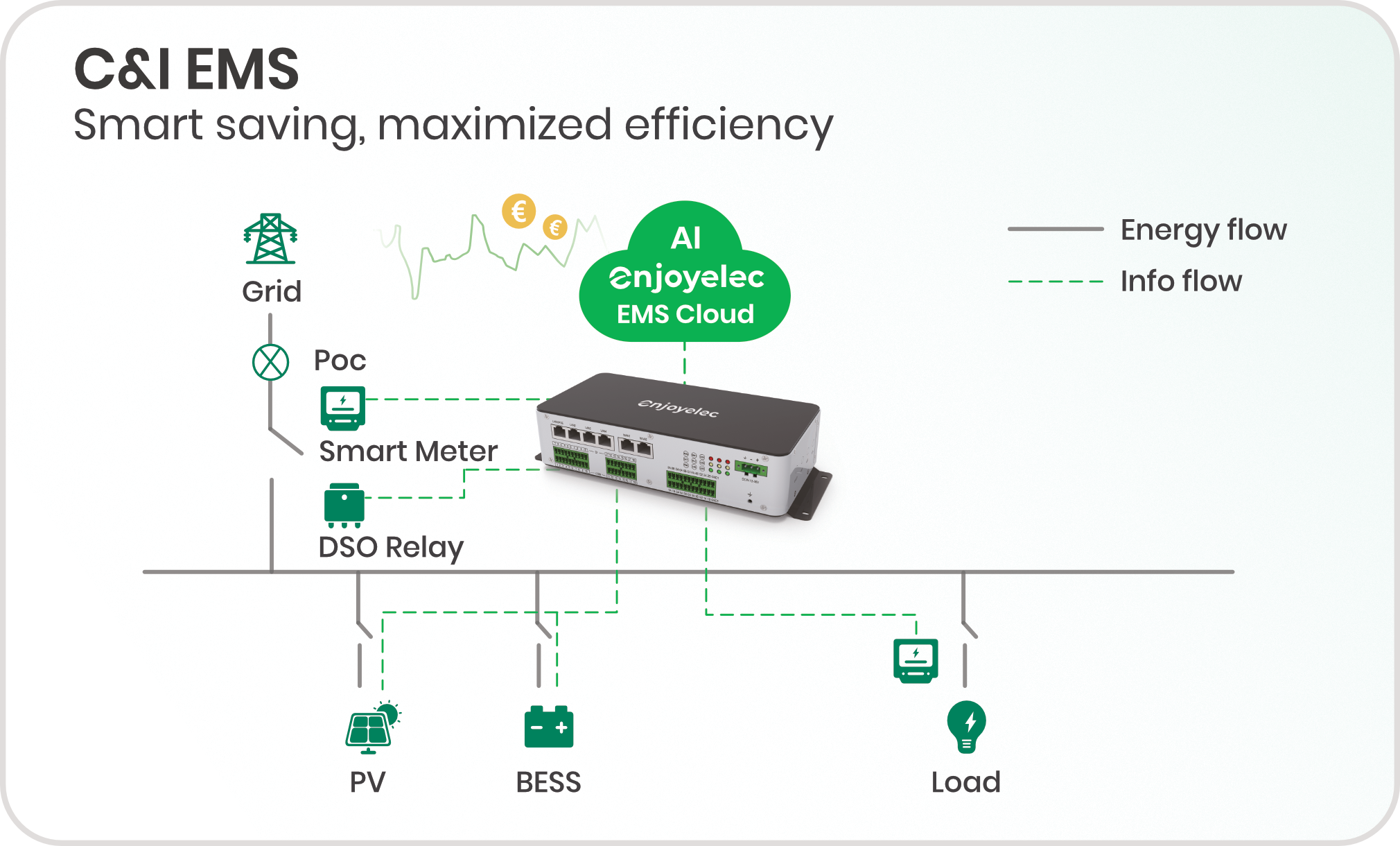
Facing volatile costs, underutilized renewables, and compliance pressure, C&I users need a strategic solution.The EMS serves as the Enterprise Energy Command Center, directly reducing costs, maximizing solar ROI, and providing verifiable carbon data to turn compliance into a competitive edge.
How it delivers value:
- Energy Arbitrage: This capability syncs factory schedules and battery cycles with price signals. It cuts costs by reducing grid draw at peak rates and creates revenue by selling stored power during price spikes, either to the grid or other site loads.
- Grid Feed-in Management: Real-time monitoring and control ensure grid feed-in strictly adhere to local technical grid codes(like Germany’s VDR-AR-N 4105 for voltage-based power curtailment). The EMS automatically prevents violations that could lead to fines and, more critically, secures your ongoing grid connection rights.
- Self-Consumption Optimization: It performs real-time optimization between your solar output, flexible factory loads (e.g., compressors, HVAC), and battery storage. This maximizes on-site consumption of green power, creating predictable energy costs and reducing grid dependence.
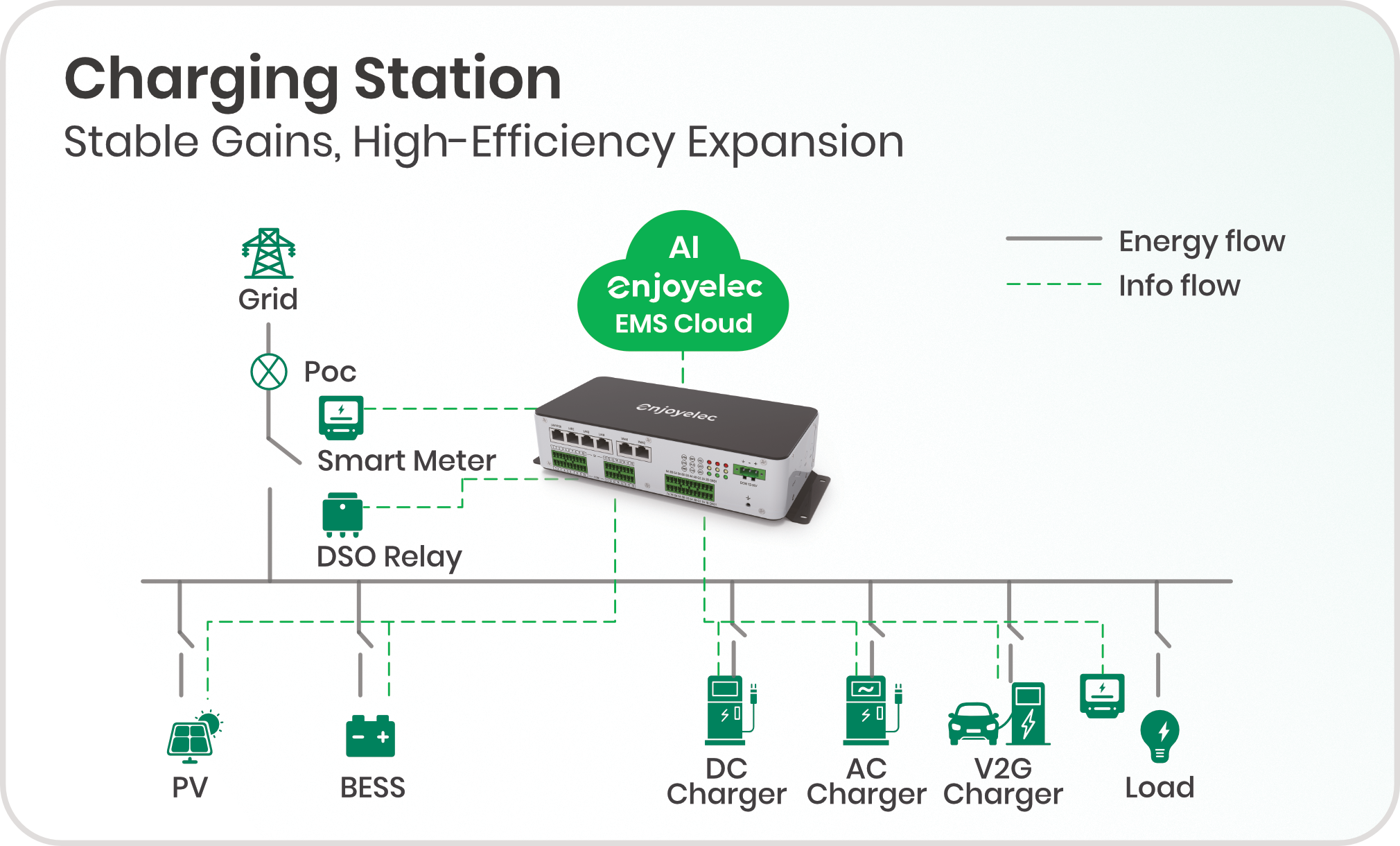
2. Large-Scale EV Charging Station Operations
The central tension is between fast-charging demand and strict grid capacity with punitive demand charges. The EMS acts as the Smart Charging Orchestrator, sequencing loads to flatten peaks, avoiding penalties, and maximizing site throughput.
How it delivers value:
- Virtual Grid Expansion: This EMS-driven capability creates elastic capacity from a fixed grid connection. Through intelligent orchestration – dynamically sharing power and using on-site storage as a buffer – it allows a station to serve more vehicles and increase daily throughput, avoiding costly grid upgrades.
- Load Management: This function establishes the EMS as a predictive cost controller. By shaping the station’s load profile through smart scheduling and real-time power adjustments, it prevents sharp demand peaks to avoid punitive charges. This transforms energy from a volatile cost into a predictable operating expense, ensuring site profitability and grid stability.
- V2G: The EMS transforms parked EV fleets into dispatchable grid assets. By managing bidirectional power flow, it enables stations to sell stored power back to the grid during peak prices, monetizing idle vehicle time to create a revenue stream independent of charging fees.
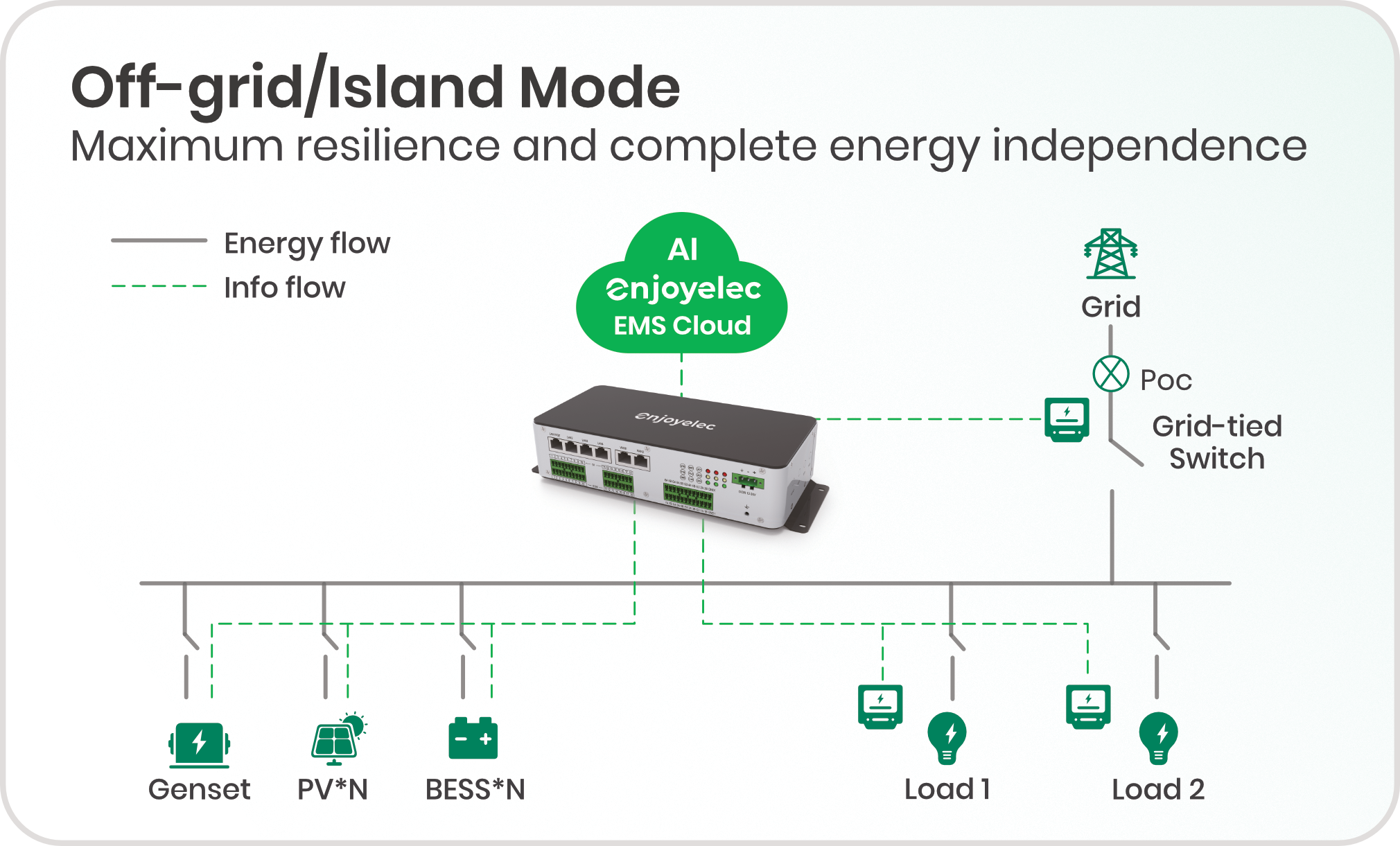
3.Ensuring Off-Grid Resilience
Facing the critical challenge of maintaining real-time power balance in off-grid environments with high renewable penetration, the EMS acts as the Stability & Optimization Brain. It coordinates solar, storage, and backup generators to guarantee 100% autonomous reliability while maximizing clean energy use and minimizing fuel dependency.
How it delivers value:
-
Grid-forming Control: The EMS provides the essential, non-negotiable grid-forming control. This capability enables a mix of solar and batteries to independently establish a stable mini-grid from a black start and maintain perfect voltage and frequency. It lays the foundation for autonomous, utility-grade power for critical off-grid sites like telecom towers or medical clinics, with no reliance on an external grid.
-
Hybrid Generation Scheduling: The EMS performs continuous, real-time economic optimization of all assets. By calculating the most cost-effective source for every kilowatt-hour based on live fuel prices, battery health, and solar forecasts, it delivers the lowest possible energy cost for the isolated system.
-
Higher System Performance: Through advanced algorithms, the EMS actively protects and optimizes core assets. It prevents battery stress and optimizes generator runtimes, significantly extending equipment lifespan and reducing lifetime fuel and maintenance costs.
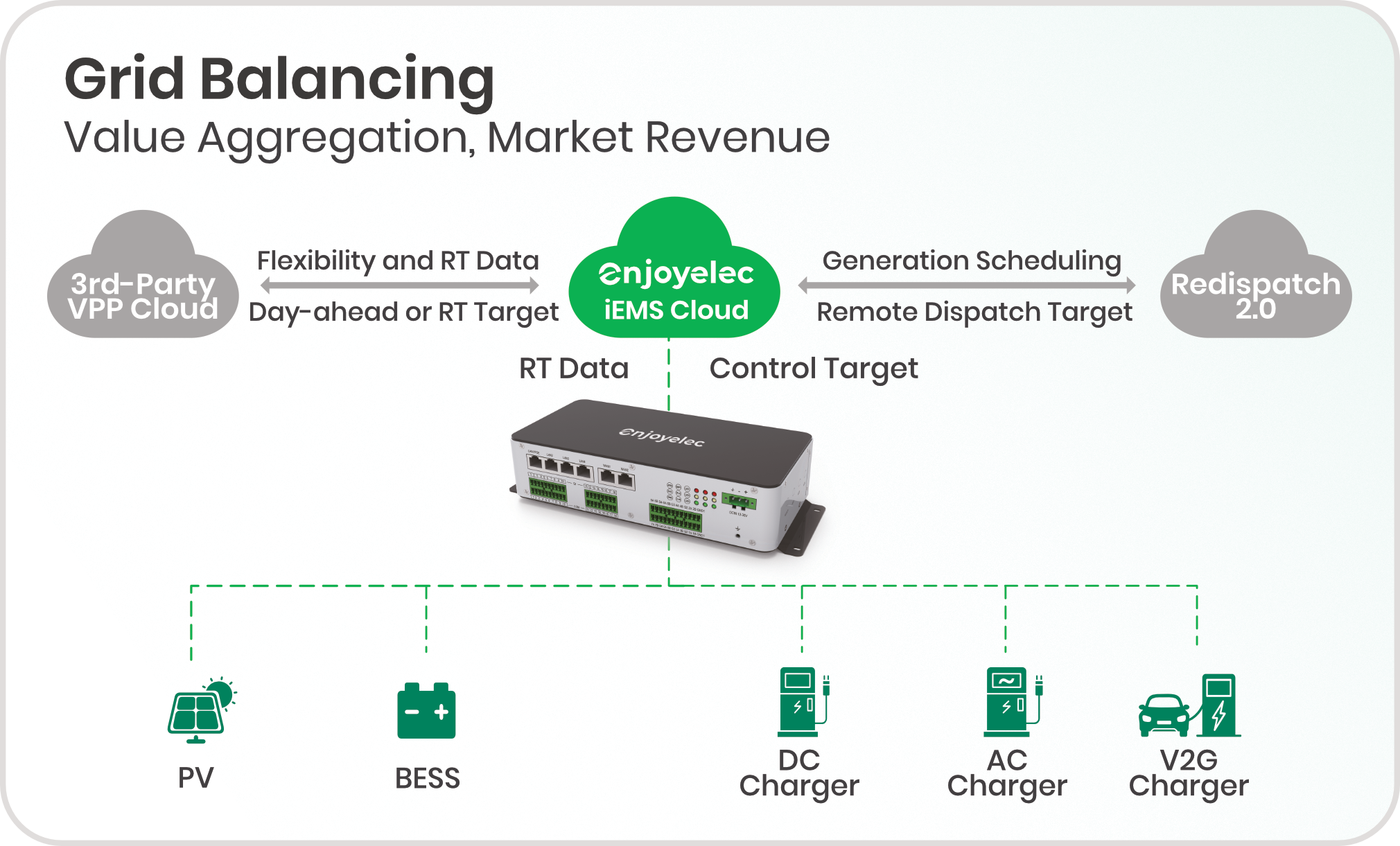
4. Participation in Grid Balancing Services
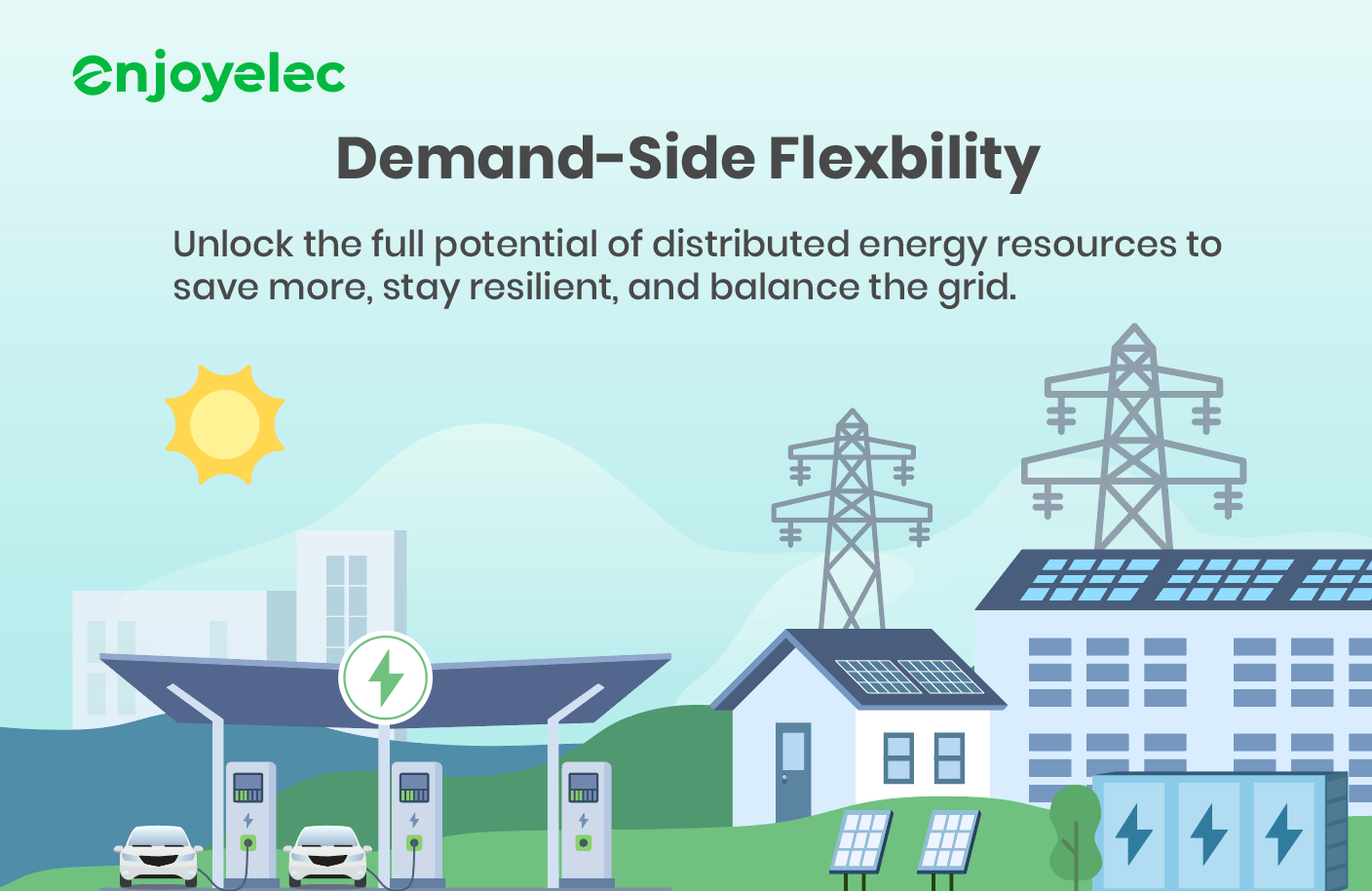
Facing the challenge of untapped, distributed resources lacking market access, the EMS acts as a Virtual Power Plant (VPP) Engine. It integrates diverse assets into a single, dispatchable portfolio to automate participation in grid services like frequency regulation, unlocking new revenue.
How it delivers value:
-
VPP Asset Integration: Empowers your distributed assets to seamlessly integrate with third-party VPP platforms. Our system provides the critical data aggregation, optimization, and reporting required to qualify as a credible grid resource and execute in day-ahead and real-time markets..
-
Energy Regulatory Compliance: Automates compliance by ensuring every asset’s response adheres to complex market rules, turning a manual burden into a system-assured foundation.
-
Target Disaggregation: Intelligently disaggregates bulk grid signals into precise setpoints for each asset, considering real-world operating constraints to deliver accurate, non-disruptive responses.
Across these four scenarios, a common thread emerges: the modern EMS is far more than a monitoring tool. It is the intelligent operating system for energy. In an era defined by volatility, it provides the control, foresight, and automation necessary to transform energy from a chaotic expense into a source of resilience, revenue, and competitive differentiation. The strategic question is no longer if you need an EMS, but when you will deploy yours to seize this decisive advantage.