From Installed Assets to Flexible Assets: Why Europe’s Next Energy Challenge is System Orchestration
From Asset Expansion to System Orchestration
For more than a decade, the European energy transition has created an unprecedented installed base of distributed energy assets, already deployed across residential, commercial, and industrial environments.
By 2025, the EU solar fleet exceeded 400 GW of installed capacity while around 28 million installed heat pumps were operating across the region. At the same time, battery storage systems and electric vehicle (EV) charging infrastructure continue to scale rapidly, further accelerating the decentralisation of Europe’s energy system.
This expansion has fundamentally changed the nature of energy management, as it increasingly takes place within existing systems rather than starting from scratch.
The next challenge is energy orchestration or the ability to make the assets already in place to work together.
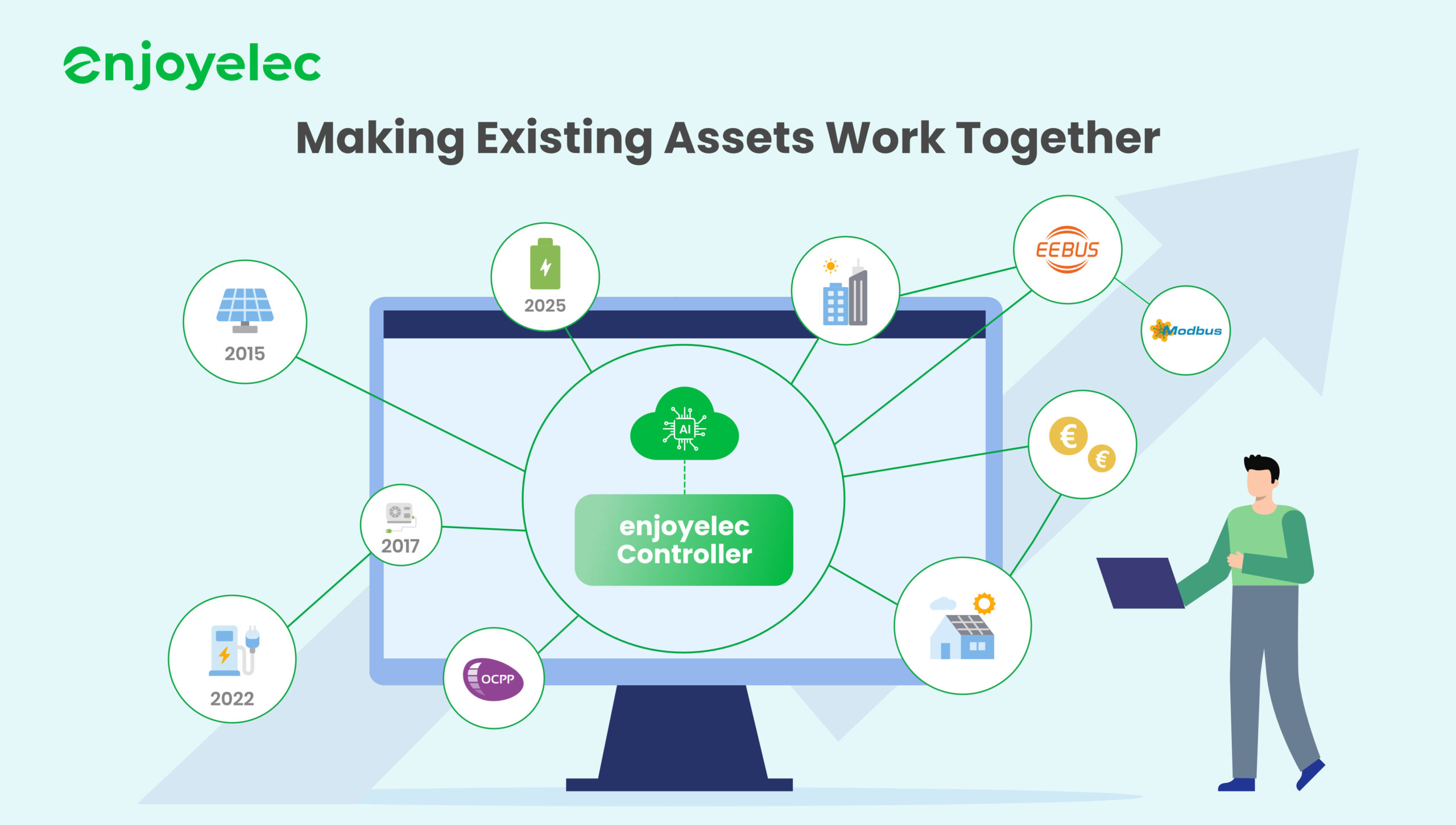
The Challenge of Heterogeneous Energy System
Unlike greenfield deployments, existing installations present a fundamentally heterogeneous environment. A typical energy site now combines assets intalled across different periods, each governed by varying operational assumptions.
● Protocol Fragmentation: While PV inverters may support granular power control via Modbus, heat pumps often rely on limited signals like SG Ready.
● Asymmetric Control: EV chargers frequently integrate via OCPP, yet older building management systems may offer only basic monitoring, lacking active control pathways.
This diversity creates challenges that extend far beyond simple device connectivity.
Different communication protocols, inconsistent control capabilities and fragmented operational data make it increasingly difficult to coordinate assets as one integrated energy system.
Besides, energy assets such as PV systems and heat pumps typically have long operational lifecycles, often ranging from 10 to 20 years, replacing existing equipment solely for digital integration purposes is neither economically efficient nor operationally realistic.
As a result, interoperability is no longer simply about enabling communication between devices. It has become the foundation for system-level optimisation across increasingly heterogeneous infrastructures.
What Modern Energy Management Systems Must Enable
To effectively manage and optimize existing energy systems, modern EMS platforms must go beyond basic connectivity and deliver true system-level coordination capabilities.
1. Interoperability Across Heterogeneous Assets
Modern energy systems rely on a growing variety of devices from different manufacturers, each using its own communication protocol and control logic. Supporting standards such as Modbus, EEBUS and OCPP is therefore a fundamental requirement for modern EMS platforms.
However, interoperability alone does not create an intelligent energy system.
The real challenge is enabling assets with different communication interfaces and control capabilities to participate in a shared optimisation strategy. Whether the objective is maximising self-consumption, responding to dynamic tariffs, participating in flexibility markets or supporting grid-aware operation, every connected asset should contribute to a coordinated system objective rather than operating independently.
This is where interoperability evolves into orchestration. By abstracting heterogeneous device capabilities and translating them into unified control strategies, modern EMS platforms enable existing assets to operate as one intelligent energy system.
2. Retrofit Compatibility and Scalable Deployment
As highlighted in energy retrofitting practices across Europe, retrofit approaches focus on extending the functionality of exiting infrastructure through digital and data-driven upgrades rather than physical replacement. In other word, making the existing assets digitalized and smarter instead of expensively rebuilding from scratch.
To enable this, energy management systems is set to connect existing assets through local gateway or cloud-to-cloud integration. By integrating dispatchable assets into an unified system, energy management systems can thus enable smart control, and AI-powered strategies under grid constraints, fulfilling regulatory compliance requirements (like 14a EnWG) and participating in further dynamic marketing services.
3. Unified Visibility across Existing Energy Assets
Existing assets are often distributed across different vendor ecosystems, each providing different levels of visibility and operational data. This fragmented landscape makes it difficult to assess overall system performance or identify optimization opportunities.
Modern energy management systems therefore need to aggregate and integrate data from heterogeneous existing assets within a unified platform and operational layer. Beyond monitoring, this enables actionable insights such as anomaly detection, performance benchmarking, predictive maintenance, and AI-driven optimization across the entire energy system.
Click here to explore enjoyelec Installer Portal with full visibility.
From Fragmented Assets to Unified Intelligence
At enjoyelec, we believe the EMS platform is more than a communication gateway—it is the intelligence layer that orchestrates heterogeneous energy assets into one coordinated system. By combining local execution, open interoperability and AI-driven optimisation, controller-centric energy management enables existing infrastructure to become more flexible, efficient and future-ready without unnecessary replacement.
👉 Learn more about enjoyelec HEMS solutions for residential applications and iEMS solutions for C&I scenarios.