Understanding Revenue Stacking: How Modern Energy Storage Maximizes Value Across Multiple Markets
Battery energy storage is increasingly recognized as a key enabler of modern power systems. Yet the financial success of storage projects often depends on more than simply installing the hardware. The real value lies in how intelligently that capacity is used.
This is where revenue stacking comes into play.
Revenue stacking refers to the strategy of maximizing the economic value of energy storage asset by capturing multiple revenue streams across different markets, services, or time periods.
Why Revenue Stacking Matters
A battery that performs only one function leaves money on the table.
If you only use it for backup power, it often remains idle most of time. If you only do peak shaving, you miss opportunities when electricity prices spike. If you only respond to grid signal, you ignore the daily rhythm of your own energy consumption.
The problem is simple: no single application fully utilizes a battery.
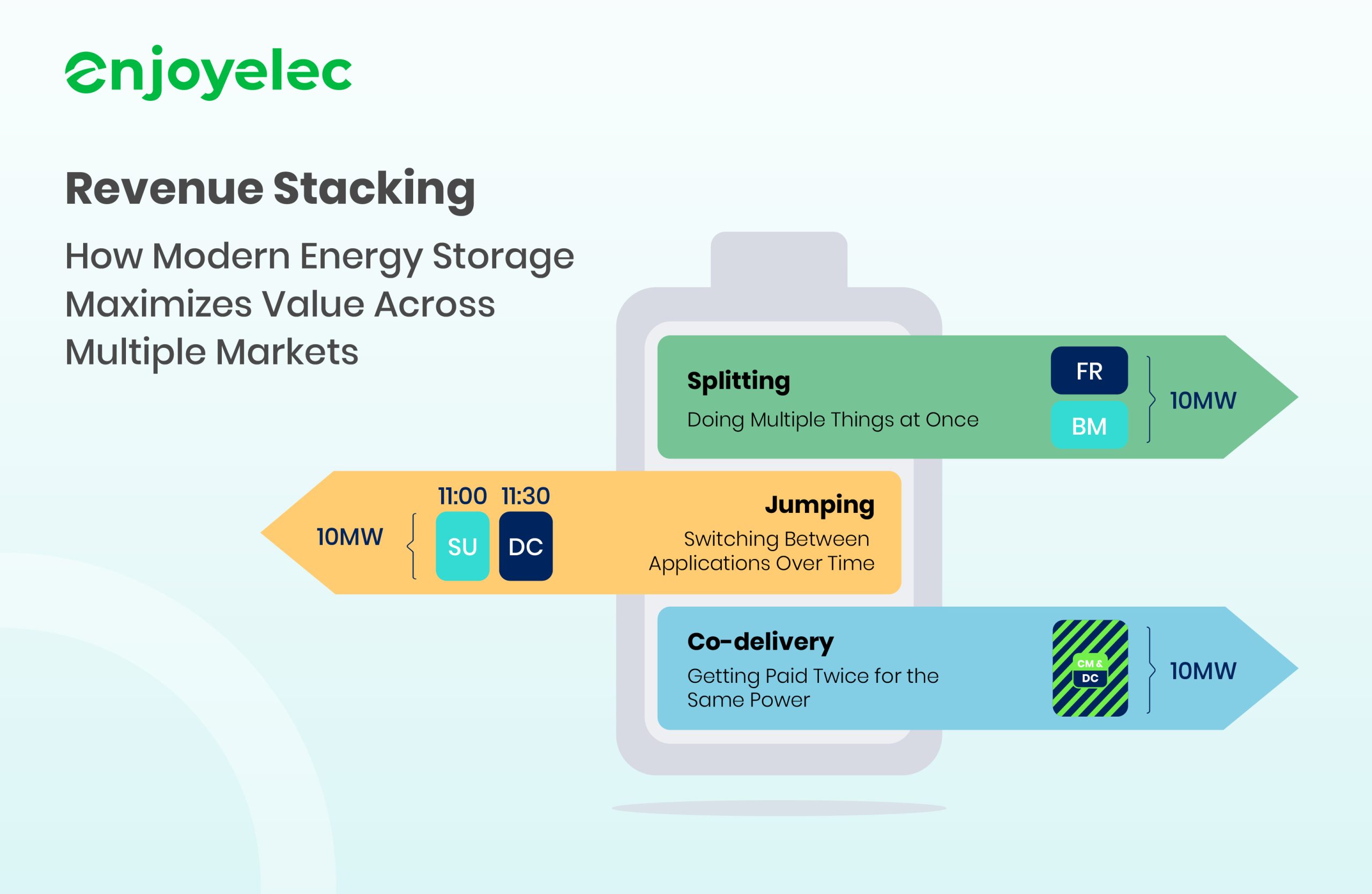
Revenue stacking solves this problem by combining multiple value streams from the same asset.The battery can switch between applications over time, or handles several at once, depending on what makes the most sense at any given moment.
Key benefits of Revenue Stacking
Utilization: Many grid services require only short bursts of power. Frequency response, for example, may last only seconds or minutes. A battery can generate revenue during otherwise idle periods by serving multiple applications
Optimization: Electricity markets and regulations are volatile. Wholesale prices fluctuate and ancillary service auctions clear at different rates. A flexible storage asset can switch between applications to capture highest-value opportunities.
Resilience: Relying on a single revenue stream exposes projects to regulatory changes and market saturation. Diversifying across applications reduces risk and improves long-term stability.
The Three Major archetypes of revenue stacking
In practice, revenue stacking can be implemented in several distinct ways. The optimal approach depends on factors such as battery capabilities, market regulations, and the technical requirements of each service.
Industry frameworks used by organizations like National Energy System Operator (NESO) in the UK generally categorize revenue stacking into three primary archetypes: Splitting, Jumping, and Co-delivery. Each represents a different approach to allocating battery capacity across multiple applications.
1.Splitting: Serving Multiple Applications Simultaneously
Splitting involves dividing a battery’s power capacity across different services at the same time. A 20MW system might allocate 10MW to frequency response services like Dynamic Containment while bidding the remaining capacity into the Balancing Mechanism.
This approach is particularly valuable when:
-Applications have compatible technical requirements.
-Market opportunities occur simultaneously.
-The battery has sufficient capacity to meet all commitments.
Key considerations: Operators must not exceed the power committed to individual applications, and doing so would lead to penalties or failed service delivery.
Splitting is among the most common forms of revenue stacking across mature electricity markets.
2.Jumping: Switching Between Applications Over Time
Jumping refers to dedicating the battery’s full capacity to different applications during different periods. The system switches based on market conditions, price signals, or operational requirements.
Typical examples include:
Adjacent use of Dynamic Containment (DC) and Scheduled Utilization (SU).
Providing frequency response during high-value grid service windows.
Performing energy arbitrage during periods of large price spreads.
The approach is particularly valuable when:
-Different markets peak at different times of day
-Technical requirements prevent simultaneous participation
-The battery needs to manage its State of Charge (SoC) between services.
Key considerations: Operators must manage SoC carefully to ensure that providing one application does not compromise availability for the next.
A specialized variation, sometimes called reverse jumping, paired services with opposite power directions. For example, after discharging to provide frequency response, the battery may recharge through the balancing mechanism while being paid to absorb energy. This approach has been used in the UK to combine dynamic frequency services with balancing market participation.
3.Co-delivery: Monetizing the Same Capacity Twice
Co-delivery is the most sophisticated and least common form of revenue stacking. It involves using the same capacity simultaneously to fulfill multiple contractual obligations, with market rules explicitly allowing this overlap.
For instance, a storage asset participating in the UK Capacity Market may also provide Dynamic Containment under certain conditions, with adjustments made during stress events.
This approach is particularly valuable when:
Market regulations explicitly permit overlapping commitments.
Applications are technically compatible.
Contractual obligations do not conflict.
Key consideration: The operational complexity is significantly higher, and the penalties for failing to deliver contracted services can be substantial.
Because of these regulatory and operational constraints, co-delivery opportunities remain relatively rare.
Availability Payments vs Utilization Payments
Beyond these operational models, many electricity markets distinguish between two types of compensation:
Availability payments: Revenue earned simply for being ready to deliver power when called upon.
Utilization payments: Additional revenue earned when the battery actually delivers energy.
A storage asset can stack these payment types as well, earning availability fees during standby periods while capturing utilization revenue during activations.
How Energy Management Systems Enable Revenue Stacking
An advanced EMS typically provides:
– Real-time optimization: Continuously evaluating market prices, grid signals, and asset status
– Multi-market integration: Connecting to wholesale markets, balancing mechanisms, and ancillary service platforms
– Automated execution: Making rapid dispatch decisions without manual intervention
– Constraint management: Balancing constraints like state-of-charge limits, degradation costs , and market participation rules while prioritizing the highest-value opportunities.
Turning Battery Storage into a Portfolio of Value
The question is no longer whether energy storage can make money, but how to maximize the value from the same installed capacity. Revenue stacking transforms battery storage from a single-purpose asset into a flexible portfolio of energy services. By dynamically allocating capacity across markets and applications, operators can significantly improve utilization, profitability, and resilience against market fluctuations.
Achieving this level of optimization requires advanced control systems capable of navigating the complexity of modern electricity markets. The future of storage is not in bigger batteries, but in smarter ones.