
MiSpeL and the New Economics of Storage: Why Germany’s Flexibility Transition Matters for Energy Management
Germany’s energy transition is increasingly shaped not only by renewable generation, but by how flexibly energy can be stored, coordinated, and used.
With the ongoing development pf the new MiSpeL (Mess- und Spezialbilanzierungsprozess) process rulesunder the framework of EEG §19, battery storage systems and bidirectional charging infrastructure are gaining greater operational flexibility within Germany’s electricity market.
While MiSpeL is often discussed as an accounting reform, its implications extend far beyond measurement rules.
The framework reflects a broader shift already taking place across Europe — one in which batteries and EV charging infrastructure are increasingly expected to participate more actively in electricity markets rather than supporting self-consumption alone.
Instead, they are becoming flexible energy assets capable of responding to electricity prices, grid conditions, and evolving market signals.
Why Earlier Rules Limited Storage Flexibility
Under previous EEG arrangements, subsidized storage systems operated under stricter charging conditions.
The earlier Ausschließlichkeitsoption, commonly referred to as the exclusivity option, generally required supported storage to charge only from associated renewable generation. Charging from the public grid could create eligibility concerns.
While designed to prevent double subsidization, the framework also constrained operational flexibility. Storage systems were often limited in their ability to participate more actively in electricity price arbitrage or combine multiple operating strategies beyond self-consumption.
The same challenge affected bidirectional charging. Because EV batteries may combine electricity from multiple charging sources over time, earlier accounting approaches created additional complexity for wider V2G deployment.
MiSpeL Signals a Broader Market Transition
MiSpeL should therefore be understood as more than a procedural revision. As dynamic tariffs, negative pricing periods, and localized grid constraints become increasingly visible across Germany’s electricity market, storage gains value not only because it stores renewable electricity, but because it can respond to changing market conditions.
The revised framework supports more flexible participation while maintaining differentiated accounting approaches under EEG participation models, representing a meaningful shift in storage economics. Under earlier operating models, batteries were typically optimized around solar self-consumption or backup functionality. Increasingly, however, storage is being positioned as a flexible asset capable of supporting broader operating strategies and interacting more actively with market signals.
The inclusion of bidirectional charging infrastructure under EEG §19 is equally relevant. MiSpeL does not remove every technical or commercial barrier surrounding V2G deployment. However, it strengthens part of the regulatory foundation needed for more flexibility-oriented operating models.
While MiSpeL is specific to Germany, the broader direction is not. Across Europe, electricity systems are becoming increasingly distributed, price-sensitive, and dependent on flexibility.
What Changes for Storage and V2G Participation
MiSpeL introduces two implementation pathways designed to support more flexible storage participation while maintaining differentiated accounting approaches. The first pathway, commonly referred to as the Abgrenzungsoption, follows a more granular delineation approach primarily relevant for larger or more operationally complex systems.
Under this model, energy flows are differentiated over defined 15-minute intervals, requiring two calibrated meters (one for renewable generation, one for grid imports passing through the battery). Operators can distinguish between renewable electricity, time-shifted energy, and electricity imported from the grid.
Although more metering-intensive, this approach enables greater operational flexibility and allows storage to participate across multiple value streams simultaneously, including:
● self-consumption optimization
● electricity price arbitrage
● peak shaving and load shifting
● export management
The second pathway, the Pauschalmodell, follows a simplified flat-rate approach intended for smaller systems where advanced interval metering may be less practical.
Rather than requiring detailed energy-flow differentiation, standardized assumptions help reduce operational complexity and lower participation barriers.
Importantly, both approaches support a more flexibility-oriented operating environment and help reduce some of the earlier complexity surrounding storage and bidirectional charging participation.
This is particularly relevant for V2G (under the new pathways only) and commercial charging environments, where batteries increasingly represent not only electricity demand, but also potential flexibility capacity.
The economics of storage and charging therefore begin extending beyond simple solar optimization toward broader flexibility participation.
Why Flexibility is Increasingly Connected to Energy Management
As batteries, bidirectional charging, and distributed energy assets respond more actively to electricity prices, differentiated energy flows, and evolving grid conditions, coordination complexity increases considerably.
For many projects, particularly in commercial and industrial environments, storage is no longer operating around a single objective such as self-consumption alone. Instead, multiple operational priorities increasingly coexist, including:
- self-consumption optimization
- price-responsive charging and discharging
- peak shaving and load shifting
- export management
- fleet and charging coordination
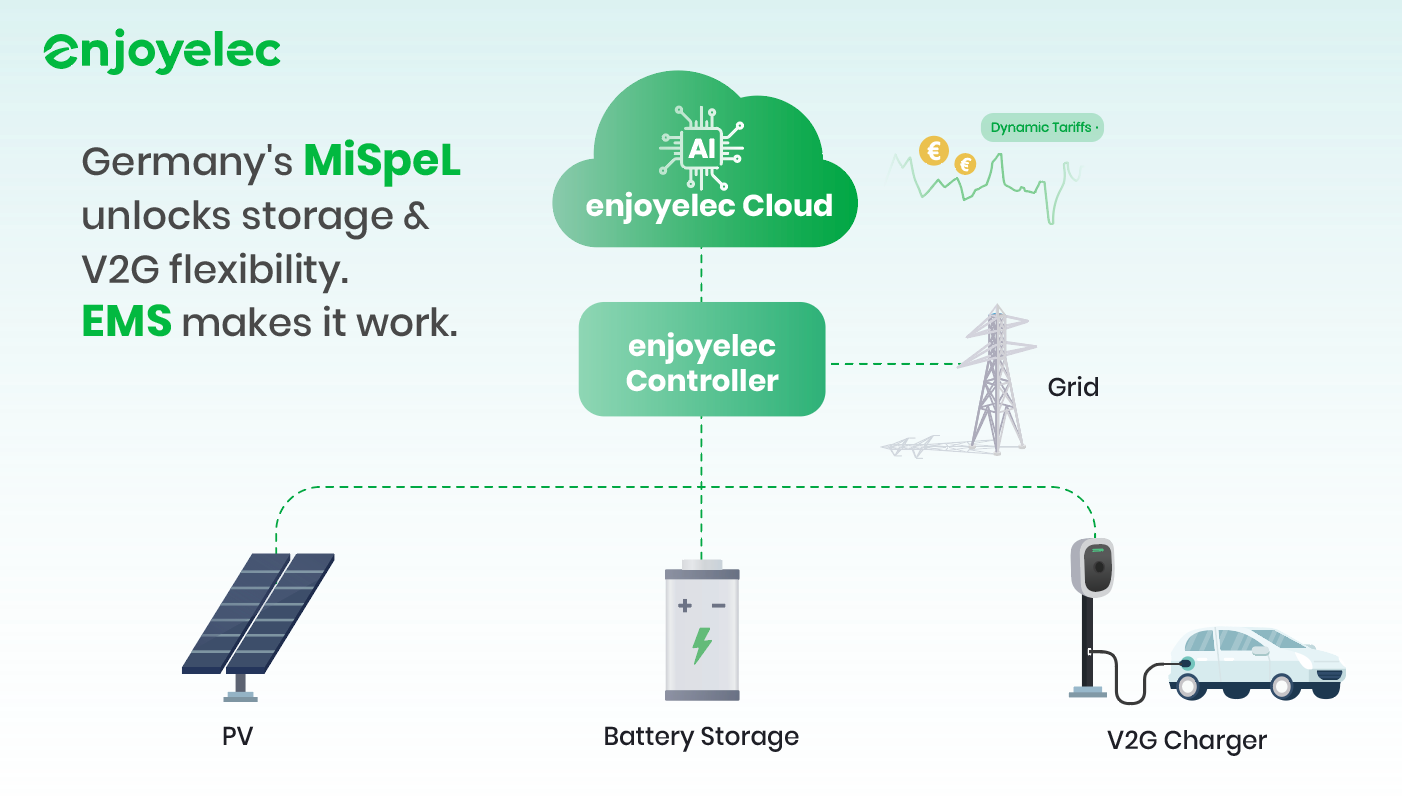
Coordinating these objectives increasingly requires managing distributed assets — including PV systems, batteries, EV chargers, bidirectional charging infrastructure, and controllable loads — within changing operating and market conditions.
Interoperability also remains a practical consideration. In Europe’s multi-brand energy environments, flexibility increasingly depends not only on connectivity but on unified coordination across different devices and manufacturers.
For energy management providers, this places growing emphasis on coordinated control, differentiated energy-flow handling, and interoperability across distributed assets.
At enjoyelec, we increasingly see this transition reflected in the growing need for more market-aware and flexibility-oriented energy management. Our controller-based HEMS and C&I EMS solutions are designed to coordinate PV, battery storage, EV charging, and flexible loads — helping support price-responsive operation and more adaptive energy coordination across residential and commercial applications.
Germany as an Early Signal of Europe’s Flexibility Transition
MiSpeL may be specific to Germany’s regulatory framework, but the direction it reflects is unlikely to remain Germany-specific. Across Europe, the industry is increasingly moving beyond the question of how to deploy more storage and other energy assets. Instead, attention is shifting toward how distributed assets can participate reliably, interoperably, and economically within evolving electricity markets.
MiSpeL does not resolve every question surrounding storage or V2G participation, but it offers an early indication of how flexibility-oriented electricity markets may evolve across Europe.
For technology providers, project developers, and energy operators alike, that shift may prove just as significant as the regulation itself.