
What happens when an energy management system can no longer rely on stable cloud connection?
Why Local Execution is Gaining Attention
The growing attention around local control in energy management systems reflects changing operational requirements within modern distributed energy infrastructures.
Historically, energy systems have relied on centralized architectures, where forecasting, scheduling, and optimization were handled via cloud-based platforms, while field devices executed control instructions on site. This approach remains highly valuable for visibility, planning, and portfolio-level optimization within energy management systems.
As distributed energy systems become more flexible, electrified, and interconnected, the importance of reliable local execution is increasing across both residential and commercial applications.
Energy assets now operate under more dynamic conditions. Market signals and tariffs change throughout the day, grid conditions fluctuate, and multiple devices increasingly share the same connection point. In this context, optimization alone is no longer sufficient to ensure stable operation. Control strategies must be executed safely, continuously, and within real site constraints, making local execution a core requirement in modern energy management systems.
Installed at site level, local controllers enhance responsiveness, continuity, and operational reliability. Their role goes beyond executing predefined schedules to ensuring system availability under real-world conditions, including communication delays, connectivity interruptions, and local constraint enforcement.
As a result, the focus is shifting from system optimization alone to the reliability of execution under real operational conditions.
How Energy Management Systems Deliver Local Intelligence
Modern energy management systems operate through physical infrastructure where communication quality, device responsiveness and site-level constraints directly influence execution. Whenever connectivity becomes unstable or communication latency occurs, control must remain available at the edge.
This is where local execution in EMS architectures provides practical value.
1. Intelligent Multi-Asset Orchestration
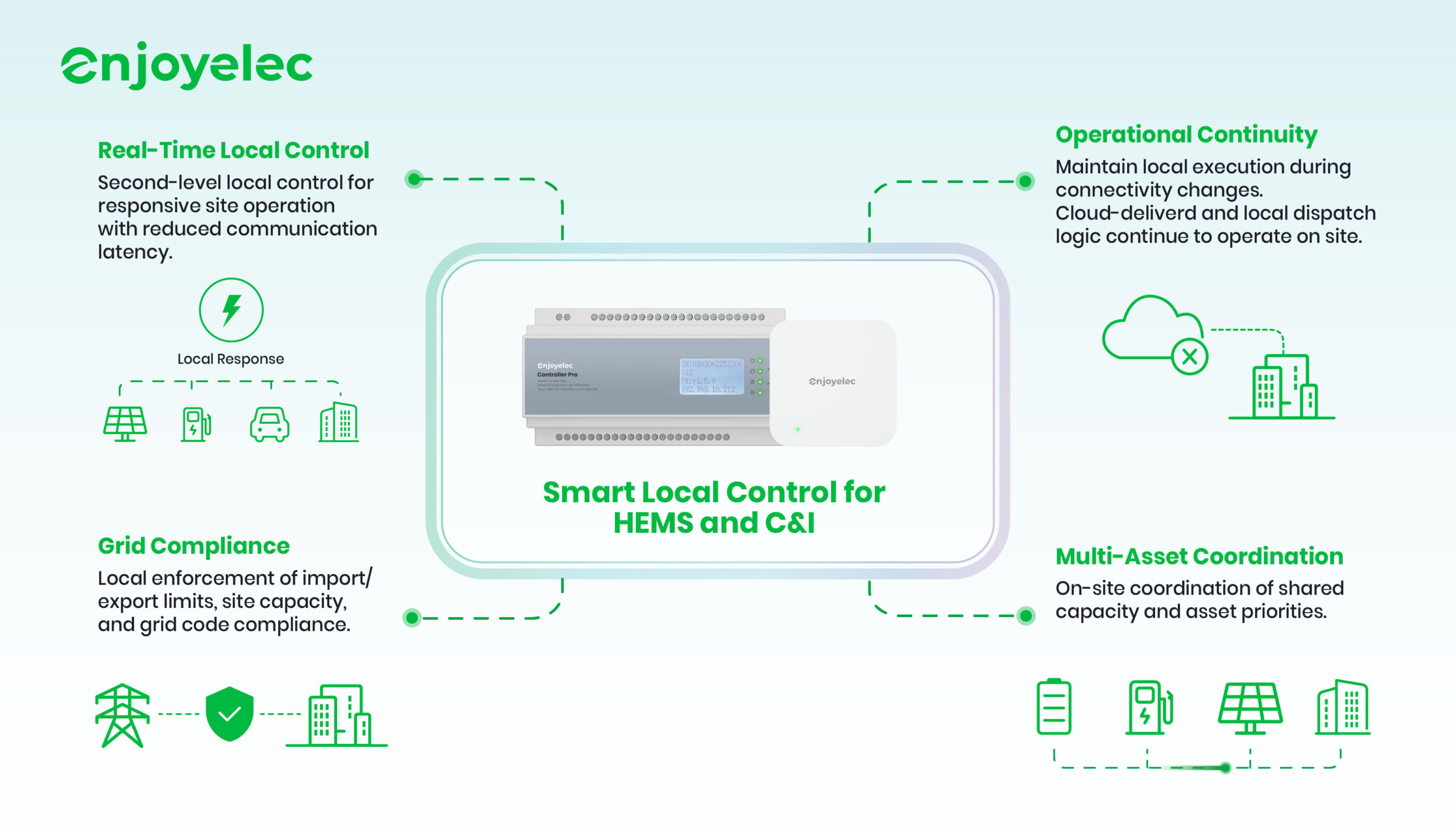
Modern energy sites often include heterogeneous assets operating under shared electrical and contractual constraints. Local platforms integrate these assets directly on site, supporting interaction between battery storage systems, EV charging infrastructure, PV generation and flexible loads according to operating priorities and available site capacity.
This helps prevent conflicting asset behavior and enables coordinated site-level operation under dynamic tariffs and changing grid conditions
2. Real-Time Site-Level Control
Solar generation, EV charging demand, battery operation and electrical loads can change continuously during daily operation. Local EMS execution enables systems to respond directly at the site level, processing real-time changes without cloud latency.
This supports fast, deterministic execution where physical energy control is required, allowing HEMS & C&I EMS systems to react more effectively to changing operating conditions.
3. Local Execution During Connectivity Changes
Communication interruptions or degraded network conditions must not interrupt critical energy operations. Local energy management platforms maintain executable control directly on site. Cloud-delivered strategies and operating parameters can continue running locally, while site-level control rules remain available within the edge platform and local controllers.
This ensures operational continuity, reducing dependency on constant cloud connectivity while maintaining system stability and controllability.
4. Constraint-Based Local Execution for Grid Compliance
Grid compliance is no longer a remote supervisory function but a core requirement of local energy control. Local EMS platforms acts as an on-site control layer that enforces grid constraints directly at the connection point. By embedding regulatory frameworks into the local control logic, the system autonomously manages export/import limits and capacity constraints with high precision. This ensures seamless grid integration and reduces non-compliance risks, regardless of cloud latency or communication status.
Tailered Local Management Capabilities for Residential and C&I Applications
Residential Applications: HEMS (Home Energy Management Systems)
In residential enegry management, peak demand charges, instantaneous load spikes, and potential connectivity issues present critical operational challenges. The enjoyelec HEMS addresses these challenges through robust local execution and edge control.
1. Manufacturer-Independent Local Integration
Our HEMS Controllers support local integration of inverters, batteries, heat pumps, EV chargers, and other distributed energy assets through Ethernet, Wi-Fi and open communication protocols including Modbus、EEBUS、OCPP and CAN. This architecture enables direct device communication without relying on cloud connectivity, reducing vendor lock-in, simplifying retrofit deployments and improving interoperability across residential energy systems.
2. Real-time Local Response
Enable real-time response through direct device communication and edge computing, avoiding cloud latency and supporting millisecond-level reaction to changing load conditions and grid signals.
3. Grid-compliant Local Control
Support grid-compliant operation through embeded control logic and potocol translation capabilities. Enable reliable execution of DSO control signals and regulatory requirements such as §14a EnWG and §9 EEG, including autonomous load reduction and grid-aware control under constrained grid conditions.
4. Operational Resilience & Data Sovereignty
Maintain critical control functions locally through a decentralized edge architecture. Core optimization strategies continue operating during communication disruptions, supporting self-consumption, peak shaving and load balancing without reliance on continuous cloud connectivity. Local data processing also enhances data sovereignty, privacy and operational resilience.
Commercial & Industrial Application: C&I EMS
For C&I projects, local control execution capability is increasingly a prerequisite for grid interconnection, cost control, and regulatory compliance. enjoyelec’s high-availability C&I EMS architecture is designed to deliver reliable continuity and operational resilience.
1. Autonomous Edge Control
Combine centralized cloud management with autonomous local execution. Optimization strategies are synchronized to edge platforms and local controllers for continued operation, while intra-day schedules can also be configured locally. During communication interruptions, critical functions continue operating on site without disruption. Operational data is buffered locally and automatically synchronized once connectivity is restored, reducing dependence on continuous cloud connectivity while supporting greater operational resilience and data sovereignty.
2. Grid-Compliant Local Management
Support grid-aware operation through locally executed control strategies and configurable grid constraints. Dedicated interfaces for DSO signal reception, feed-in limits and demand constraints enable compliance with requirements such as §9 EEG. Local execution helps reduce curtailment, optimize available grid capacity usage, and accelerate integration of solar, storage and flexible loads.
3.Modular & Scalable Local Intelligence
The local EMS architecture is designed for flexible commissioning and long-term asset scalability. New energy applications, such as advanced peak shaving or flexibility service models, can be deployed as modular edge configurations withou core system changes or site downtime. This enables rapid adaption to evolving regulations and unlocks new revenue streams across the project lifecycle.
Drive the Smart Energy Future with enjoyelec